Whose God is on the dollar bill?
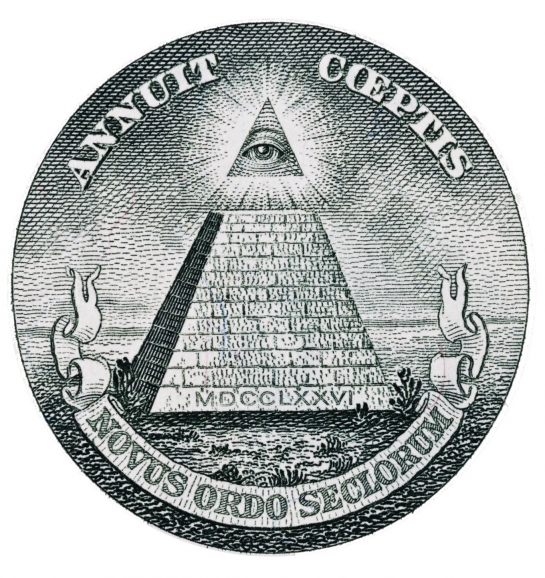
Great Seal of the United States (reverse)
Art is too often seen as a literal representation of the artist's own small, physical world. The idea that it uses metaphoric language to express much larger, eternal truths shared by all mankind is seldom realized. The same happens with the dollar bill. Six local Republican legislators want to pass a law in Westchester County, New York, requiring display of the motto "In God we trust" in legislative chambers. Their spokeswoman told a reporter that "this great nation was founded on Christian principles and beliefs, but the motto may be applied to broader reasoning."1 That interpretation is, in fact, more accurate than that of the atheist group, the Freedom From Religion Foundation, who sued to have the motto removed from U.S. currency because it promotes religion. The Supreme Court rightly ruled that it does not. It promotes spirituality which is religion-free and universal.
Thomas Jefferson, George Washington and many other Founding Fathers were Christian by culture but philosophers first. They did not believe in a God that intervened in the universe. The conventional Christian "God" made no sense to them. They believed that "God", the creative power in nature, was neutral and that, if we could but see beyond the borders of our own small, physical lives, we would discover it inside us. That's why the eye in the pyramid on the Great Seal of the United States (above), also on the dollar bill, looks you in the face. It is your inner eye reflected back at you. The mythologist Joseph Campbell, commenting on how such eternal truths are mistaken for features of local culture like Christianity, explained the issue:
"[T]he elegant eighteenth-century engraving still to be seen on the back of our twentieth-century dollar bill represents a realization of the philosophical way [his italics] pursued by that extraordinary company of deists to whom we owe the establishment, in reason, of this nation. Composed of elements adapted from a hermetic tradition of great antiquity and universality..., its pictorial vocabulary is so little understood today that many suppose the word "God" of its maxim "In God we trust", to be a reference to the "God" of the Christian religion, which it is not." He goes on to say that the deists rejected the idea of Judeo-Christian revelation or that man's nature is corrupt. Religious intolerance, the Fathers believed, was blasphemy "since in their primal ground and ultimate sense, all religions are one, as is mankind."2
1. Elizabeth Ganga, "Republicans want 'In God We Trust' in county chambers", USA Today online, January 3rd 2015. Retrieved on March 20th 2015.
2. Joseph Campbell, The Inner Reaches of Outer Space: Metaphor as Myth and as Religion (Novato, CA: New World Books) 1986, pp. 95-6
Posted 20 Mar 2015: Divine ArtistMirrors / ReflectionInner TraditionReligionTheoryVisual Perception
The EPPH Blog features issues and commentary.



Reader Comments