Why Art is So Similar
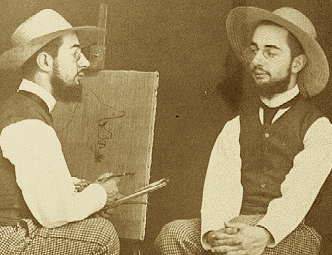
Toulouse-Lautrec, Self-portraits in "trick" photograph (c.1895)
Some readers question whether the common themes of art explained here really exist because, in their minds, art is a product of individual expression. No wonder. That is what children are told and art lovers too. Picasso, for instance, is said to have often painted the romantic and sexual aspects of his personal life as though all it takes to be an artist is a randy old man with a gift for drawing, color and composition. That, as any other interpretation based primarily on an artist's technique or personal experience, is fundamentally wrong.
Carl Jung, aware of this widely-mistaken prejudice, wrote:
“The artist is not a person endowed with free will, who seeks his own ends, but one who allows art to realize its purposes through him. As a human being, he may have moods, and a will, and personal aims, but as an artist, he is Man in a higher sense: he is "collective man", a vehicle and molder of the unconscious psychic life of mankind.”1
That's art in a nutshell.
1. Jung, Modern Man in Search of a Soul [1933] (Re-printed New York: Harcourt, Brace & World) 1961, pp. 168-171.
Posted 10 Nov 2013: Artist as Another ArtistPicassoTheory
The EPPH Blog features issues and commentary.



Reader Comments
Hello:
I am in completely in accordance with this position about the collective origin of art. But I ask, reading about the concept of Canon proposed and defended by Harold Bloom for literature. He proposes literature (at least canonical literature) as a product of individual expression. Is there something similar in painting, sculpture, etc?
Gustavo von Bischoffshausen
10 Nov 2013
Gustavo, that’s an interesting question. I have great respect for Harold Bloom so I’m not sure how to answer it. I do not recall, though, where he proposes literature as solely a product of individual expression so I may not even have read the same text. In “The Anxiety of Influence” he writes that “we need to stop thinking of any poet as an autonomous ego, however solipsistic the strongest of poets may be. Every poet is a being caught up in a dialectical relationship…with another poet or poets” (p.91). Later on he remarks that “criticism is the art of knowing the hidden roads that go from poem to poem.”(p.96) To me this suggests something very similar to my outlook on art but, I must emphasize, I am no expert on Bloom.
Does that help in any way?
Simon
Simon
10 Nov 2013
I agree totally that is part of the torture of being an artist the compulsion
jon
15 Dec 2013