Wisdom and Leonardo’s Self-Portrait
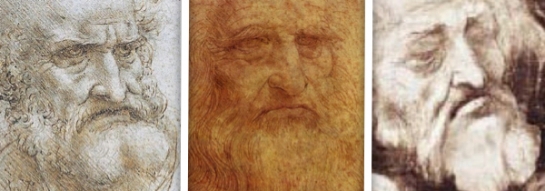
Left: Leonardo, Bearded Old Man in Half-Length (detail); Center: Self-portrait (detail); Right: Leonardo, Underdrawing of The Adoration of the Magi (detail of a magi)
One of the mysteries surrounding Leonardo’s so-called self-portrait (above center) is that it only emerged in the early nineteenth century. It was then decreed to be a self-portrait based on its likeness to the frontispiece portrait of Leonardo in Vasari’s Second Edition of The Lives of the Artists.1 Rightly so to my mind though a problem remains. Why does Leonardo look so old when he would have been only in his mid-forties at the time? This discrepancy allows art historians to ignore claims that the Mona Lisa and the “self-portrait” share the same facial proportions or that Lisa is a feminine version of Leonardo. They do not accept the “self-portrait” as an authentic self-portrait.
Martin Clayton's observation that Vasari’s engraving of a bearded Leonardo merged with the popular conception of Aristotle in the sixteenth century is important.2 It helps explain why Leonardo practiced drawing so many male heads with aged features. He was trying to express wisdom visually. Age was the symbol of Wisdom, not youth. Wisdom, moreover, is the essential goal of all traditions within esoteric Christianity and, in Leonardo’s world, that wisdom is often expressed through the head of an old man.
More than likely Leonardo drew himself as an old man – with aged features - to represent the quintessential wisdom of a creative mind like his. It is still a self-portrait. Besides, the “self-portrait” has similarities not just to the Mona Lisa but to the heads of other old men in Leonardo’s oeuvre too. I pointed out several years ago that the heads of John the Baptist and St Anne in separate paintings by Leonardo have an identical face in an identical pose. Today we now show for the first time that a well-known drawing of an old, bearded man by Leonardo (above left) is also very similar to the “self-portrait” (above center). It demonstrates without doubt that Leonardo drew a male head type based on his own features even if the so-called Self-Portrait depicts him older than he was. He was portraying Wisdom within his own mind in all his paintings. In the early Adoration of the Magi (above right) the magi on the esoteric level represent wisdom "coming to" to Christ just as the Mona Lisa is an expression of cosmic Wisdom in a fertile mind like his own.
1. On how Leonardo’s image in Vasari’s Lives of the Artists merged with the popular conception of Aristotle in the sixteenth century, see Clayton, Leonardo da Vinci: The Divine and the Grotesque (London: The Royal Collection) 2002, p. 112
2. ibid., p. 112
Posted 15 May 2011: Leonardo da VinciMichelangeloPortraitureTheory
The EPPH Blog features issues and commentary.



Reader Comments