Matisse’s La Coiffure (1901)

Matisse, La Coiffure (1901) Oil on canvas. 95.2 x 80.1 cm. National Gallery of Art, Washington, DC
Click image to enlarge.
This early and important painting by Henri Matisse depicts his wife, Amélie, facing a mirror while arranging her hair. Hair has a long but little-known history in art, going as far back as Titian, linking the similarity of its texture and composition to the hairs of a paintbrush. The subject, as ever, must be art which means that the female nude facing the mirror represents the artist facing his painting which is represented within the painting as the mirror on the wall. Mirrors often represent paintings, in part because they are an age-old metaphor for the mind's surface and, in part, because if every painter paints himself, every painting must reflect the artist.
Click next thumbnail to continue

Detail of Matisse's La Coiffure
Click image to enlarge.
Another form to note is Amélie's black hair enclosed within her symmetrically bent arms, both hands adjusting it and facing inwards. Like Matisse himself with his hand facing the canvas, she is in the process of composing her hair. Taken out of its apparent context, though, the overall shape resembles a giant eye with a large black pupil, thereby linking - as I so often point out - the unity of hand and eye, of craft and perception. However, in making her head his "pupil", he also associates thinking with sight.
Click next thumbnail to continue
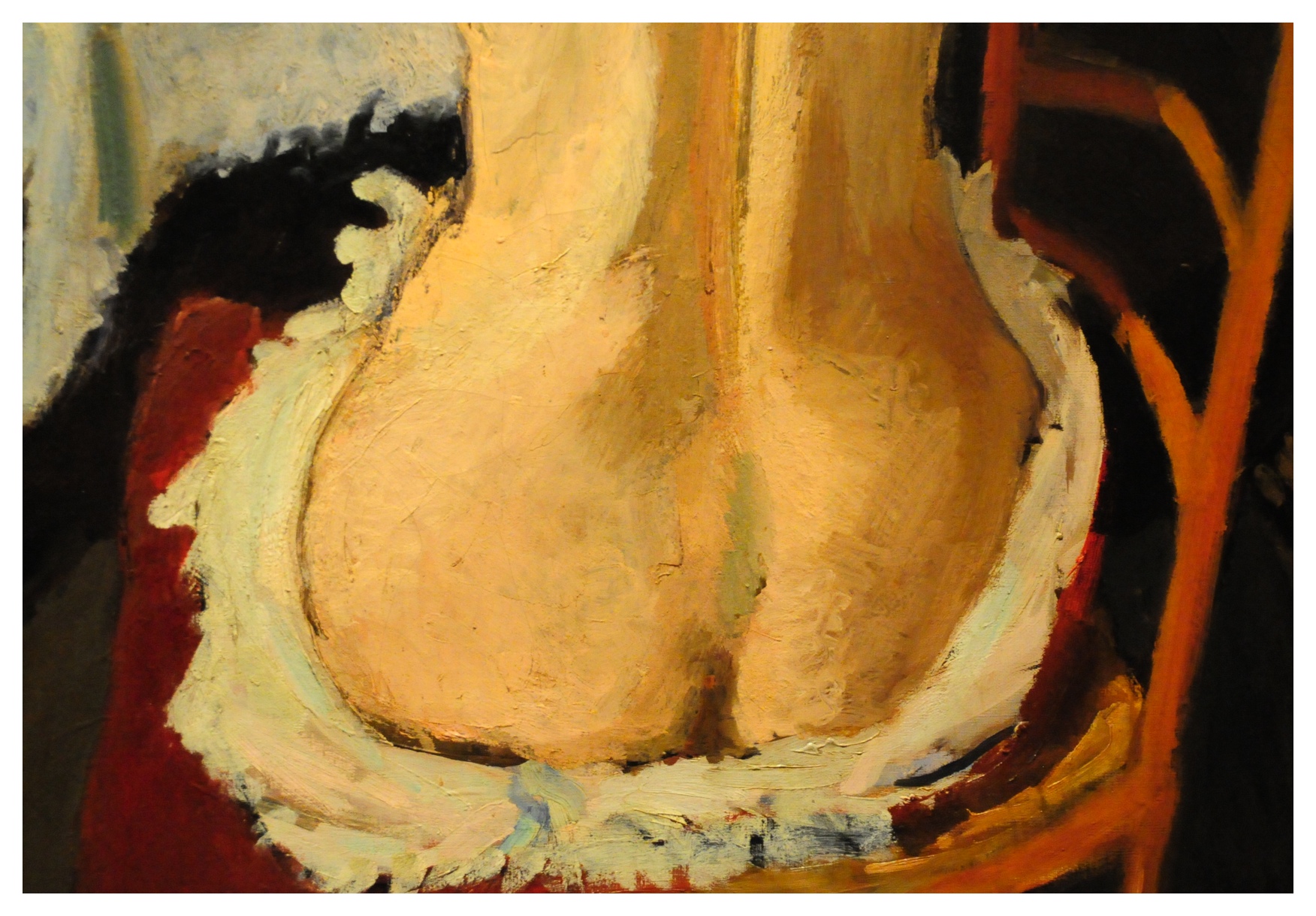
Detail of Matisse's La Coiffure
Click image to enlarge.
Her lower torso, where her womb is located, emerges from a white contour on a background of red. Circular, it too may represent an "eye" with white for the white of the eye and red for blood behind it. Thus, instead of two eyes horizontally placed, as we expect them, we have two "eyes" vertically placed.
Click next thumbnail to continue
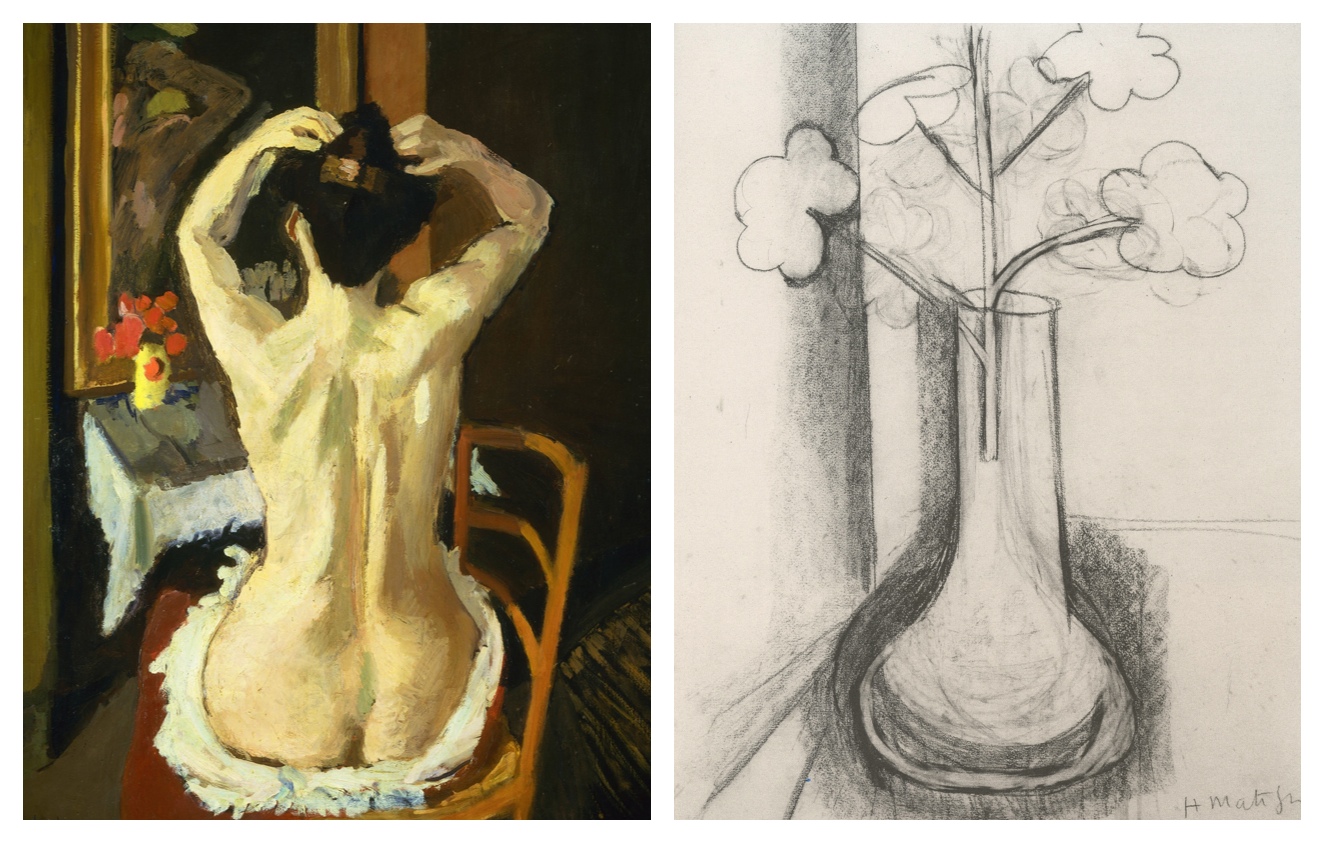
L: Matisse, La Coiffure (1901)
R: Matisse, Geranium in a Vase (1915-16) Charcoal on paper.
Click image to enlarge.
The fertile one in the womb below, then, would represent a physical eye with the upper one as his inner eye, the two connected by her torso.1 One grows out of the other which may even explain why her figure resembles a vase of flowers by Matisse.
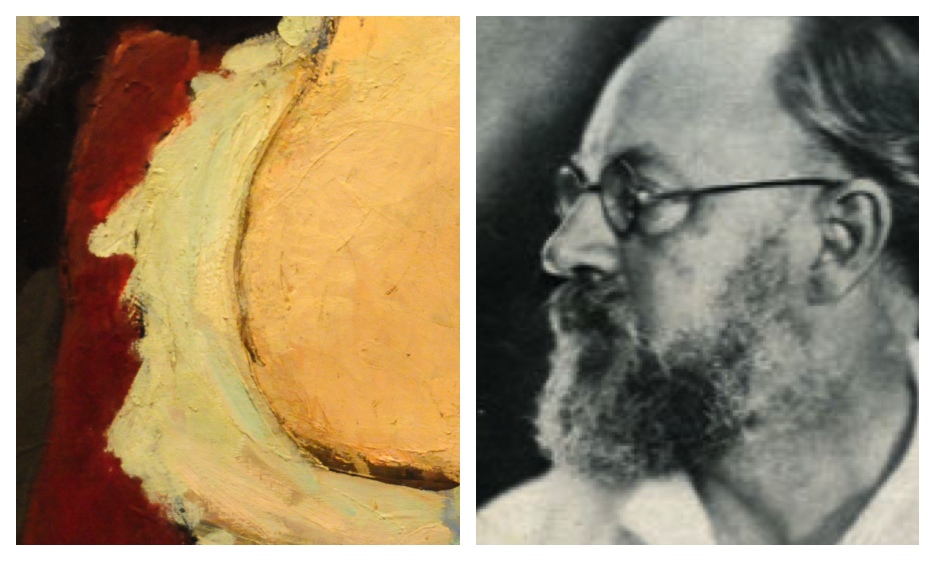
L: Detail of Matisse's La Coiffure
R: Detail of a photograph of Matisse on the cover of Time Magazine (1930)
Click image to enlarge.
Lastly, do note a detail that never has been: the contour of her white dress is Matisse's profile. Thus from Matisse's inner eye, her womb, emerges Amélie's inner eye, her head. I recently revealed a similar illusion in Lord Leighton's masterpiece, Flaming June (1895). No doubt the two developed their ideas independently because I will soon show something similar in a painting from the 17th century.
More Works by Matisse
Notes:
1. In Renaissance diagrams of the head, the inner eye is almost always shown above the real eyes.
Publication Date: 07 Apr 2013
© Simon Abrahams. All articles on this site are the copyright of Simon Abrahams. If you wish to use copyrighted material from this site in print or other media for purposes that go beyond 'fair use', you must obtain permission from the copyright owner. Other websites may link to this page without permission (in fact, please do) but may not reproduce the material on their own site.