Matisse’s Woman in Blue (1937) and Ingres’ Moitessier (1856)
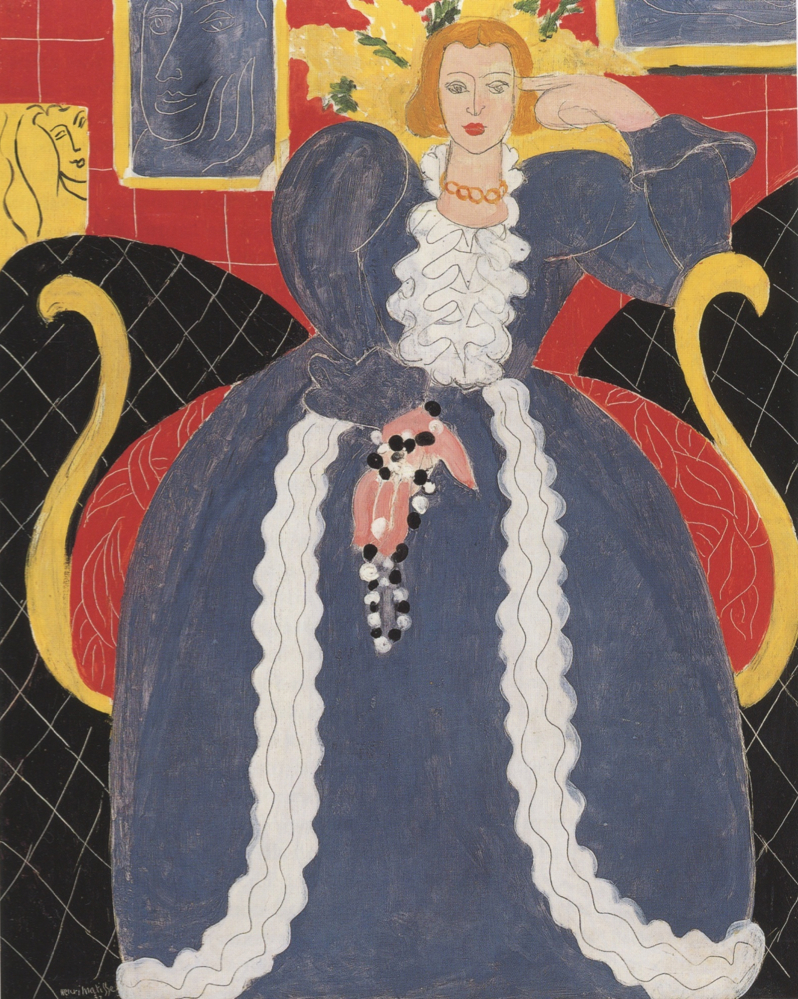
Matisse, Woman in Blue (1937) Oil on canvas. Philadephia Museum of Art
Click image to enlarge.
Matisse had an odd relationship with portraits, painting them quite often while still remarking: "No. I seldom paint portraits and if I do only in a decorative manner." John Klein believes that Matisse's statement asserts that "self-expression" was his priority.1 It also implies that the sitter's expectations were not one of Matisse's main concerns either; what mattered most were the dictates of his art. Take, for example, his Woman in Blue (at left).
Click next thumbnail to continue
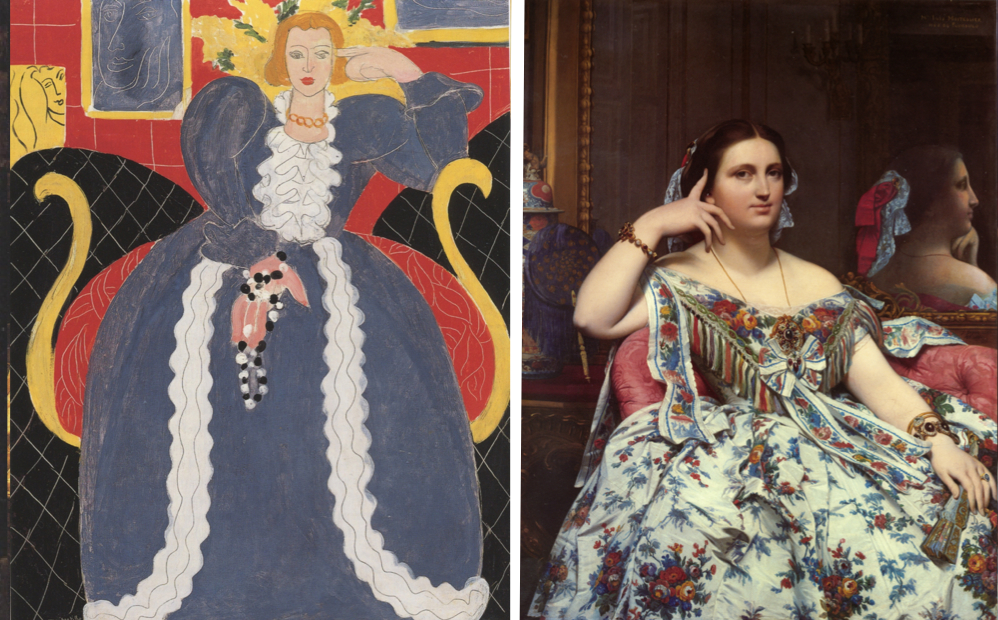
L: Matisse, Woman in Blue
R: Ingres, Madame Moitessier (1856) Oil on canvas. National Gallery, London
Click image to enlarge.
It has long been known that Matisse's woman is based on Ingres' portrait of Madame Moitessier2 whose finger pressed against her temple signifies mental activity, an unusual feature for a nineteenth-century depiction of a woman awash in expensive fabrics. Social butterflies were not thought to think.
Click next thumbnail to continue
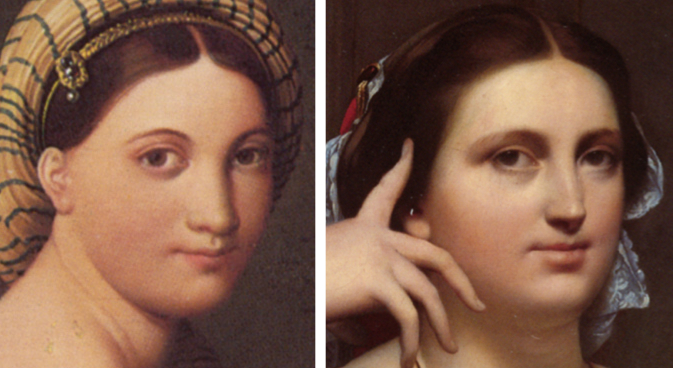
L: Ingres, Detail of La Fornarina's head from Raphael and La Fornarina (1814)
R: Ingres, Detail of Mme. Moitessier (1856)
Click image to enlarge.
However, no-one has noted that Ingres' Moitessier (near left) is a slightly plumper and older version of how he had portrayed Raphael's "muse and mistress", La Fornarina, 42 years earlier (far left). This means that Moitessier's portrait is not just that of a rich man's wife but of Ingres' muse. Matisse would certainly have known that.3
Click next thumbnail to continue

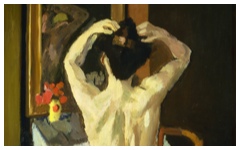
Detail of Matisse's Woman in Blue (1937)
Click image to enlarge.
Matisse's woman, like Ingres', has an index finger on her temple but Matisse's points. We have shown elsewhere that a pointing finger often "paints" but here an enormous hand takes aim at her brain and eye.4 Concisely expressed, all three of an artist's most important symbols for the self are represented in that one gesture: the hand, eye and mind.5 In short, Matisse's Woman in Blue, whose ginger hair would have matched Matisse's when young, represents the fertile feminine half of the artist's androgynous mind, as Mme. Moitessier, La Fornarina, the Mona Lisa and Parmigianino's Anthea do too. She is both subject and object of Matisse's art; she "paints" herself.

Notes:
1. John Klein, Matisse Portraits (New Haven: Yale University Press) 2001, p. 24
2. ibid., p. 23
3. See the entry on Raphael's La Fornarina
4. See the theme Pointing and Touch.
5. See the theme Hand and Eye
Publication Date: 01 Dec 2011
© Simon Abrahams. All articles on this site are the copyright of Simon Abrahams. If you wish to use copyrighted material from this site in print or other media for purposes that go beyond 'fair use', you must obtain permission from the copyright owner. Other websites may link to this page without permission (in fact, please do) but may not reproduce the material on their own site.