Munch’s Coastal Landscape (1918)
A friend of Edvard Munch, a Polish writer called Stanislaw Przybyszewski, described the alternative ways of viewing a painted landscape: "Two people see a landscape. One sees it with his pitiful brain: impressions of light, colors, forms, lines, a beautifully ordered conglomeration, dull, dead, banal and boring." The other sees "lines take on pulsating life, they relate to the most intimate spiritual life, they blend with spiritual forms, and we become one with the landscape."1
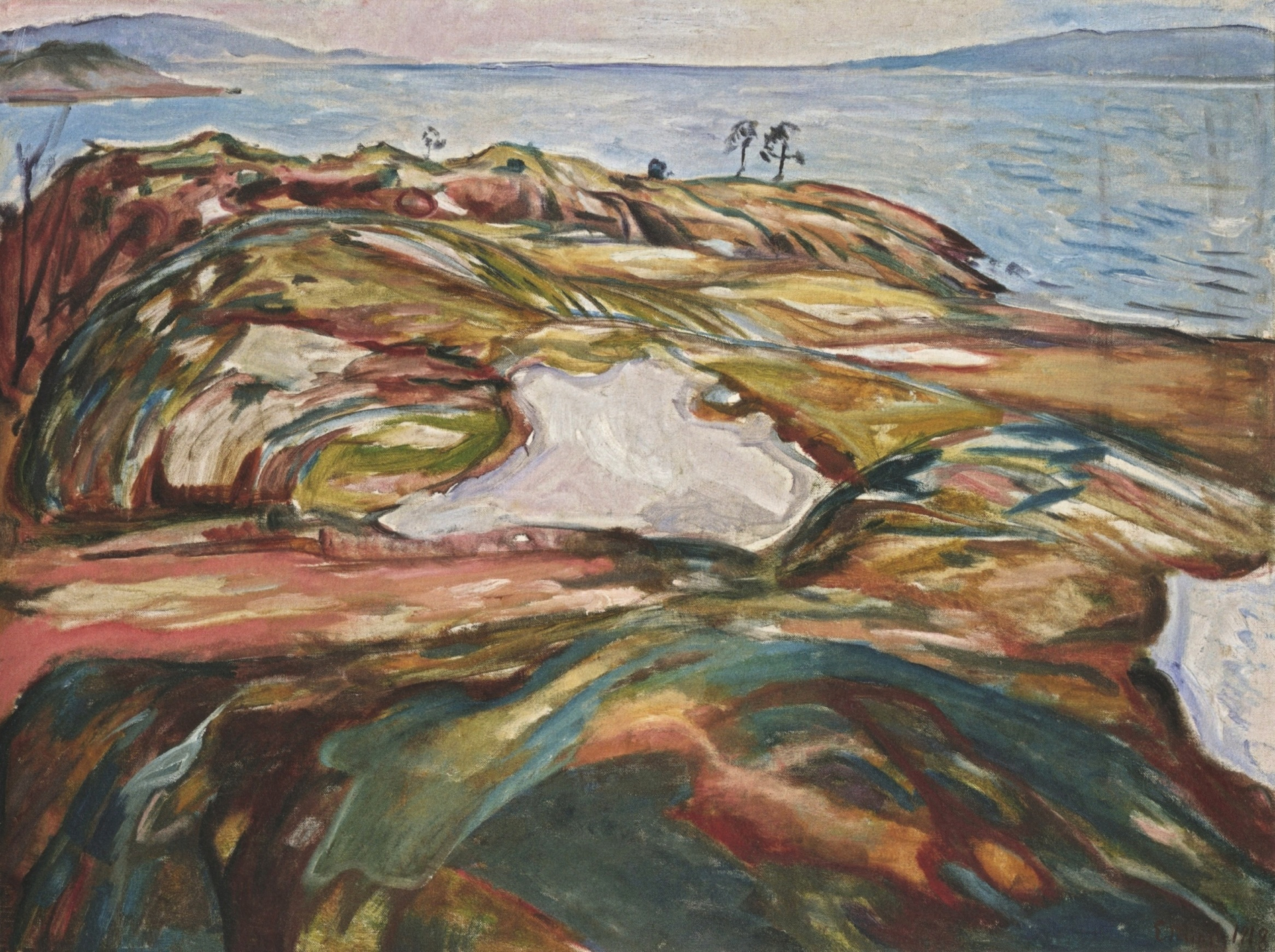
Munch, Coastal Landscape (1918) Oil on canvas. 120.9 x 160 cm. Kunstmuseum, Basel
Click image to enlarge.
That quote is cited by the Basel museum which owns the painting at the beginning of a catalogue entry for Coastal Landscape (left). Near the end they conclude that "transitions are created in a wide variety of ways..[so that] the space in the picture and the viewer's space is dissolved." Very true....but that's not all.
Click next thumbnail to continue
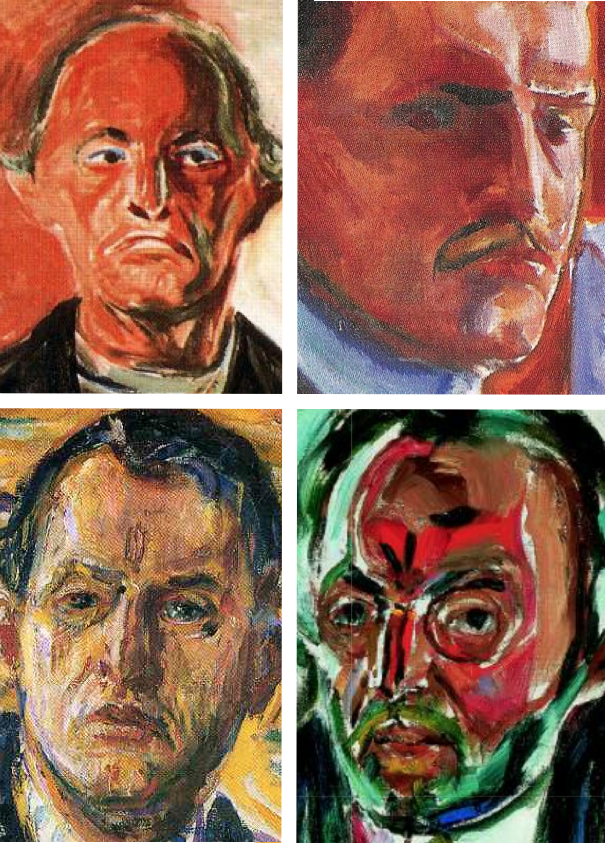
Self-portrait details from (top left, clockwise): Self-portrait by the Window (1940), Self-portrait with Wine Bottle (1906); Self-portrait after the Spanish Flu (1919); Self-Portrait at Professor Jacobson's Hospital (1909)
Click image to enlarge.
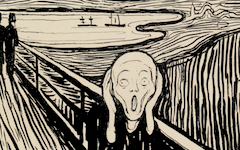
To really see what is happening in a landscape it helps to know what the artist looked like, at least in his self-portraits (left). Munch had a powerful stare, a long, straight nose and often, but not always, a down-turned mouth. In some cases (lower right) when he portrayed his mouth normally, his moustache still continues to give the same bell-curve effect.
Click next thumbnail
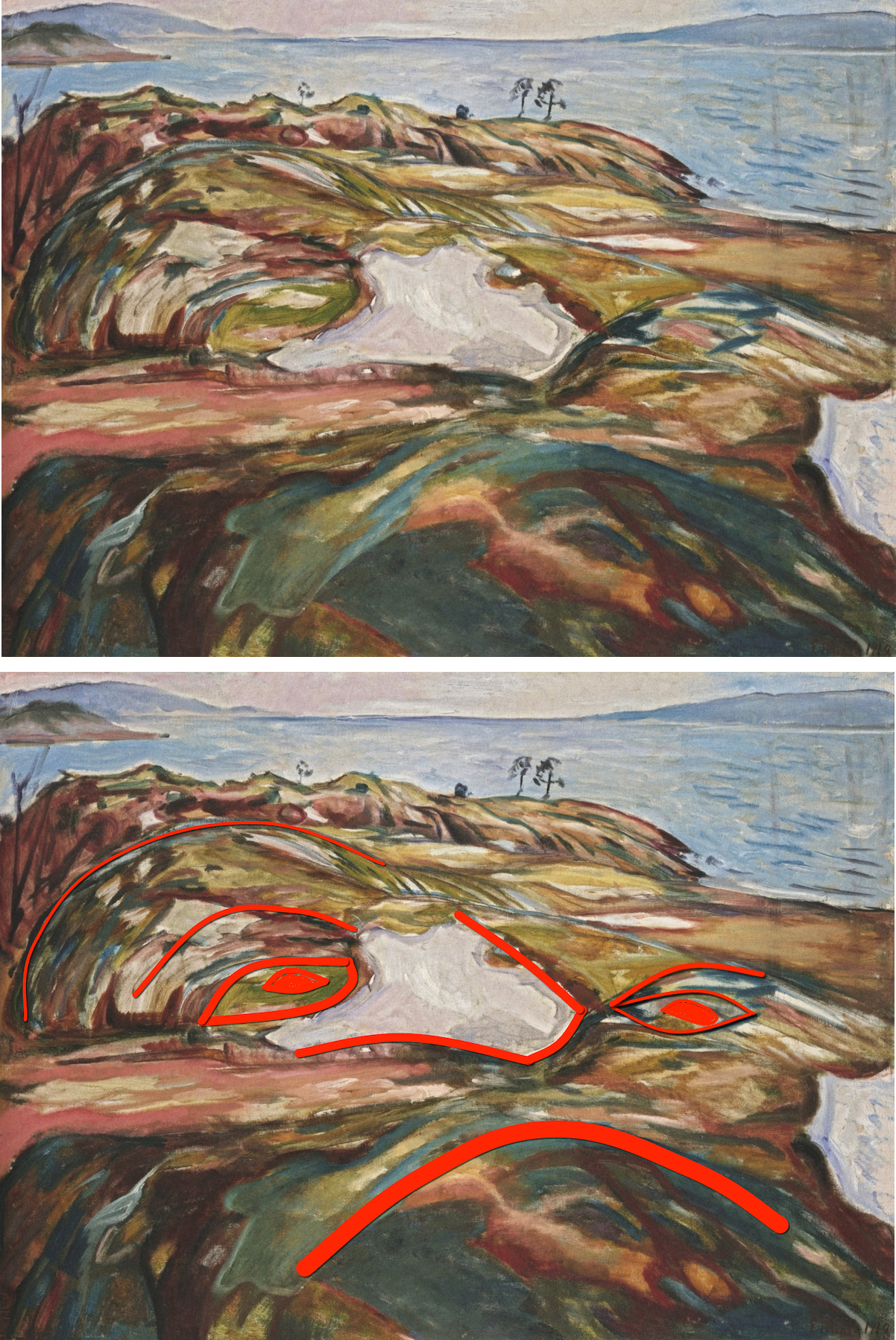
Top: Munch's Coastal Landscape (1918)
Bottom: Diagram of above
Click image to enlarge.
Once known, it is difficult to avoid seeing that Munch has become the landscape. His face, anamorphically viewed from below, is fractured.2 Reality in most philosophies is not the way we see the world. Forms need to be shattered to find the truth. Meister Eckhart, the 14th century mystic, said "to get at the kernel means breaking the shell"3 while Rumi, the Sufi poet, wrote: "If ye pass beyond form, O friends, 'tis Paradise and rose-gardens within rose-gardens."4
Click next thumbnail to continue
Munch, Coastal Landscape (1918)
Click image to enlarge.
Vincent van Gogh once wrote that he never painted a landscape that didn't have a figure in it and, unknown to the art world, this is what he meant.5 Twenty years ago I used to think that landscape was "dead, dull, banal and boring" too. Now I know it wasn't the landscape that was dull but my perception.
More Works by Munch
Notes:
1. Cited by Dorothee Gerkens in Kunstmuseum Basel: The Masterpieces (Ostfildern: Hatje Cantz) 2011, p. 178
2. See "Cubism Explained" for a description of how objects in mental images are most likely to be distorted and fragmented and seen from multiple viewpoints. See also Botticelli's Birth of Venus, Part Two.
3. Franz Pfeiffer, Meister Eckhart, vol. 1 (Leipzing) 1857, trans. C de B. Evans (London: John Watkins) 1924, p. 259
4. The Mathnawi of Jalâlu'ddin Rûmi, vol. 3, tr. Reynold A. Nicholson (London: Gibb Memorial Series) 1926-3, p. 578
5. H. R. Graetz, The Symbolic Language of Vincent van Gogh (London: Thames & Hudson) 1963, p. 21
Publication Date: 01 Sep 2014
© Simon Abrahams. All articles on this site are the copyright of Simon Abrahams. If you wish to use copyrighted material from this site in print or other media for purposes that go beyond 'fair use', you must obtain permission from the copyright owner. Other websites may link to this page without permission (in fact, please do) but may not reproduce the material on their own site.