Picasso’s Faun Flutist (1947)

Picasso, Faun Flutist from Dos Contes (1947) Engraving
Click image to enlarge.
No-one familiar with Picasso’s work can fail to recognize his alter ego in this flute-playing faun. Nevertheless, the artist made his self-identification even clearer by making the two flutes resemble the P of his signature: two lines at an angle with a roundish shape on top. Thus the two pipes spell PP for Pablo Picasso.
Click next thumbnail to continue

Top: Signature from Self-Portrait (1902)
Bottom: Signature from Portrait of a Young Girl (1958)
Click image to enlarge.
Here are two examples of his signature with P's resembling the shapes of the faun's pipes.
Click next thumbnail to continue

Picasso, Faun Flutist from Dos Contes (1947) Engraving
Click image to enlarge.
If the faun is an artist, we need to ask what he is painting and the answer can only be: the tree in front of him. Trees are heavy with symbolism already but, here, the tree as the faun's work of art also had to represent the artist. So Picasso formed the trunk into an upper-case P with a meandering line emerging from it as though from its “head”. The P alone in juxtaposition to the PP of the flute-playing faun thus expresses what great art must: every painter paints himself. Pablo Picasso the faun has made a Picasso.
More Works by Picasso
Picasso at his most abstract is still figurative in ways that have never been seen
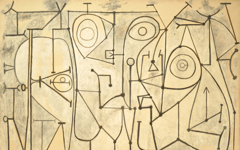
Picasso’s The Kitchen (1948)
Notes:
Publication Date: 29 Sep 2010
© Simon Abrahams. All articles on this site are the copyright of Simon Abrahams. If you wish to use copyrighted material from this site in print or other media for purposes that go beyond 'fair use', you must obtain permission from the copyright owner. Other websites may link to this page without permission (in fact, please do) but may not reproduce the material on their own site.