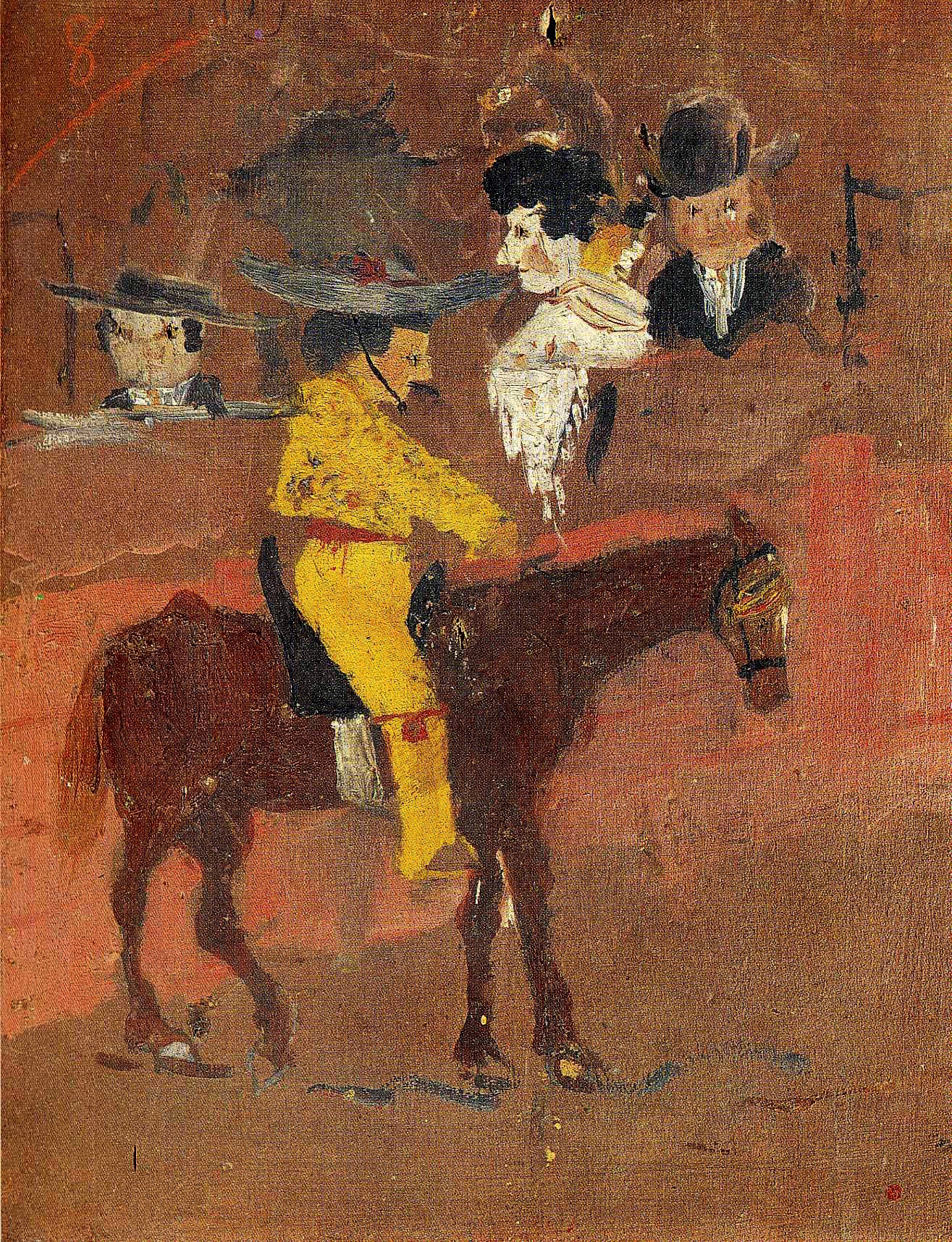
Picasso’s The Last Bull (1892)
Picasso sometimes expressed regret that he had never drawn like a child, that he always drew like an artist. I, probably like many others too, used to think that was mere boasting. Now I know otherwise: he was an artist when the rest of us were children. He put away childish things to make art.
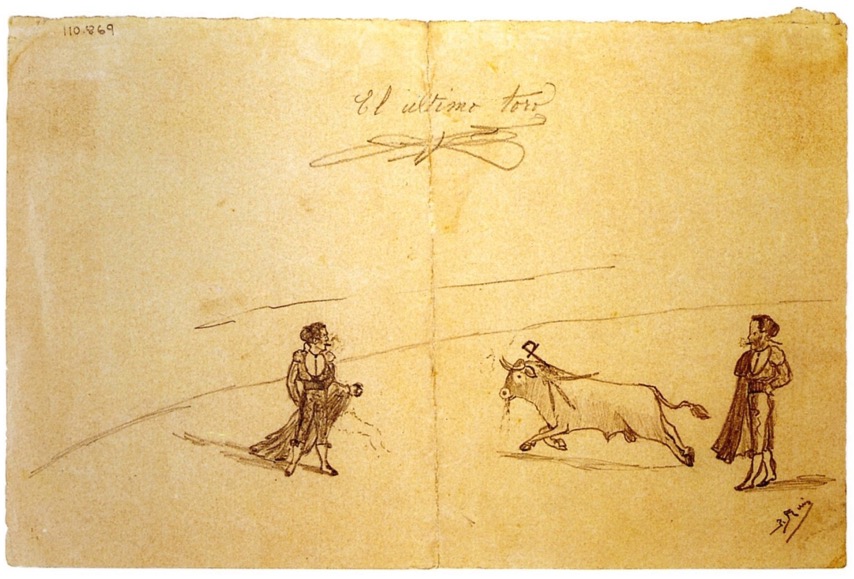
Picasso, The Last Bull, inscribed El Ultimo Toro (1892) Graphite pencil on paper. Museu Picasso, Barcelona
Click image to enlarge.
Last week we saw how the 13-year old Picasso drew a man and a woman in the shape of his own initials, PR for Pablo Ruiz as he was then known.1 Now I have discovered that in this drawing from two years earlier, he did something similar. It was a method he continued to repeat throughout his life.
Click next thumbnail to continue
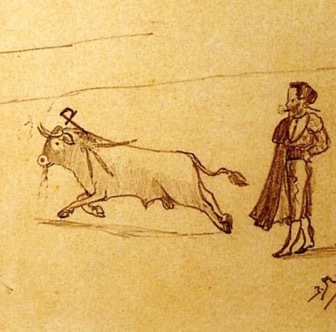
Detail of Picasso's Last Bull (1892)
Click image to enlarge.
The sword is clearly shaped to form a P for Pablo. Whether the boy knew that swords are art's age-old metaphor for a paintbrush is debatable but he had already visually associated the word picador with his mother's family name, Picasso, as I have shown.2
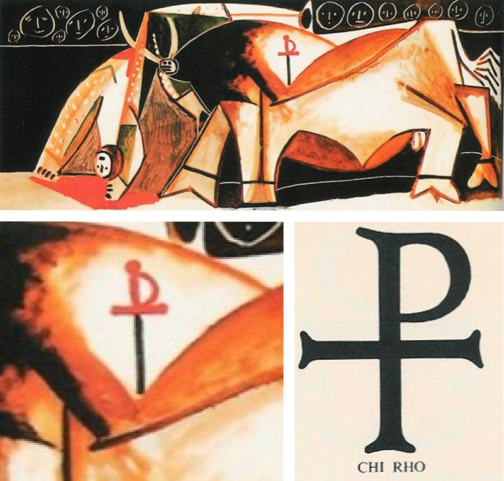
Top: Picasso, Bullfight Scene (1955) Oil on canvas.
Bottom L: Detail of above
Bottom R: The Chi Rho monogram of Christ
Click image to enlarge.
More than 60 years later he used a sword in another bullfight scene (left) now certainly aware of the metaphor and added a Christomorphic reference to Christ's monogram (lower right). He may not have intended this at the age of eleven; at 76, he surely did.
(For an analysis, see Picasso's 1955 Bullfight Scene).
Click next thumbnail to continue
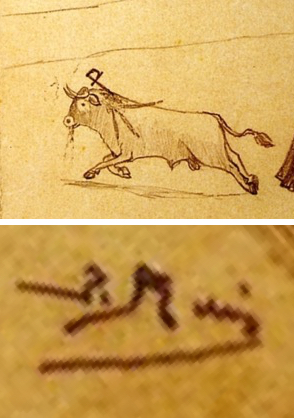
Two details of Picasso's The Last Bull, signature below rotated.
Click image to enlarge.
Picasso, like Albrecht Dürer and others before him, sometimes formed his signature to suit the scene (bottom).3 Here his "Ruiz" suggests the bull's movement. The left ascender and right foot of the strandely-shaped "R" imitate its forelegs while the line underneath echoes the bull's shadow. The latter touches the animal's hindlegs as the line touches the "z". This would be unlikely for any other child but Picasso's Picasso. He was a poet and artist at 11 years old, perhaps even earlier.
More Works by Picasso
Notes:
1. See Picasso's A Gentleman Greeting a Lady (1894-5)
2. See analysis of Picasso's A Picador (1890) in above entry, A Gentleman Greeting a Lady.
3. A good example on EPPH is Picasso’s Musician, Dancer, Goat and Bird (1959).
Publication Date: 12 Apr 2015
© Simon Abrahams. All articles on this site are the copyright of Simon Abrahams. If you wish to use copyrighted material from this site in print or other media for purposes that go beyond 'fair use', you must obtain permission from the copyright owner. Other websites may link to this page without permission (in fact, please do) but may not reproduce the material on their own site.