Renoir’s Le Cannet (1902)
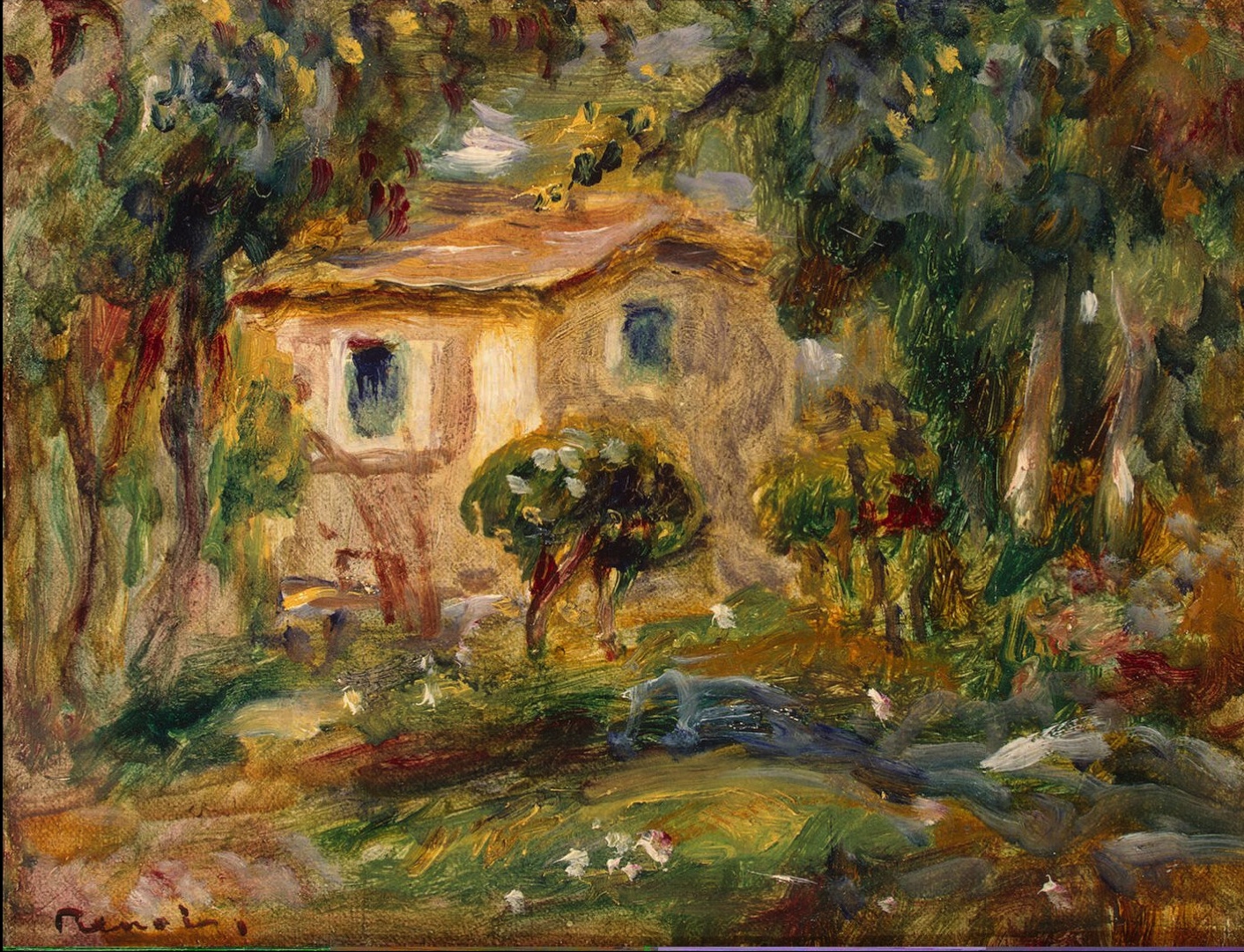
Renoir, Le Cannet (1902) Oil on canvas. The Hermitage, Saint Petersburg.
Click image to enlarge.
In a 2007 novel, The Luncheon at the Boating Party, Susan Vreeland makes Renoir deny that there any stories behind his art. “It’s not my job to think”, he says in the novel, “I paint women as I’d paint carrots.”1 That is one of the myths about Impressionist painting, recounted of Manet too. In reality, Renoir's paintings, even his landscapes, are full of thought; they are all mind.
Click next thumbnail to continue
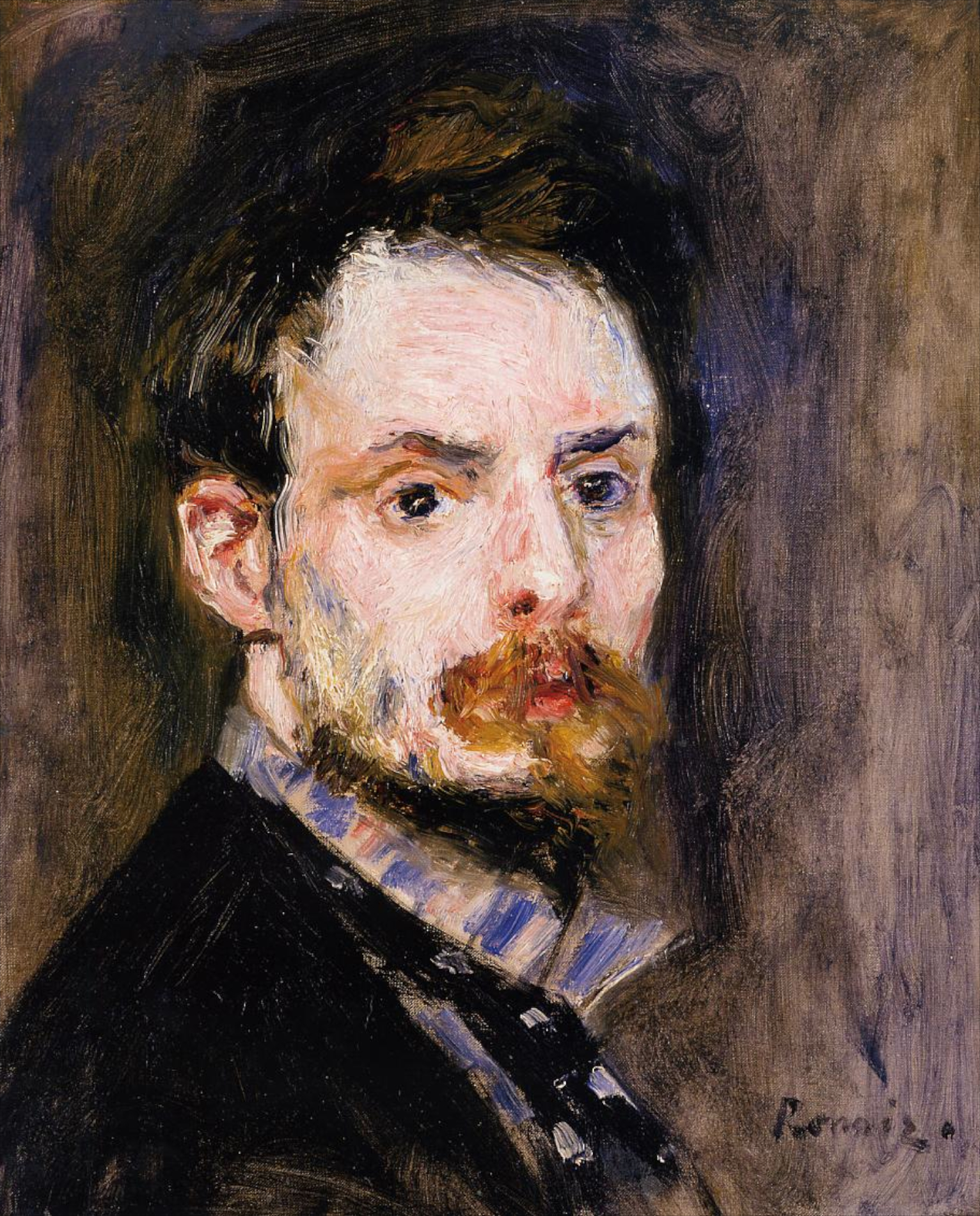
Renoir, Self-portrait (c.1875) Oil on canvas. Clark Institute, Williamsburg, MA
Click image to enlarge.
One of the tricks of interpretation is to familiarize yourself with as many self-portraits as you can. Here is one Renoir painted 25 years earlier. He had not forgotten it when he painted the house at Le Cannet in 1902 because he turned it, if the building existed, into his own face. Many artists had done likewise as well including Leonardo, Poussin, Guercino, Rembrandt, Turner and his Impressionist colleague Monet to name only a few.
Click next thumbnail to continue
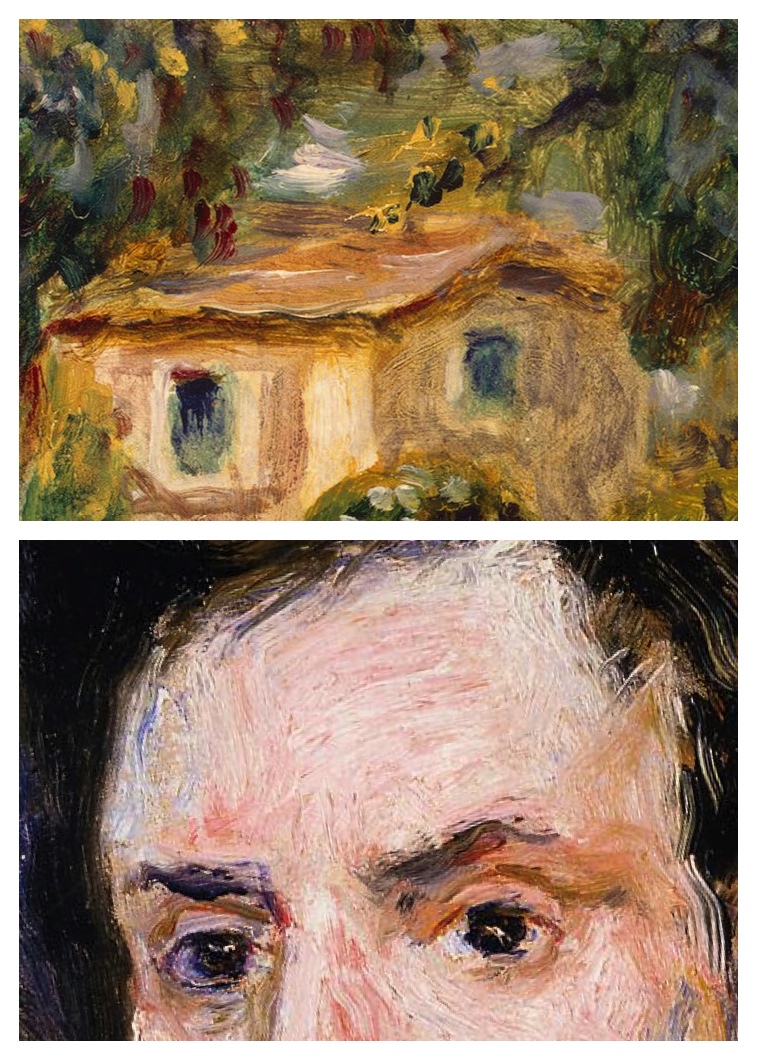
Top: Detail of Renoir's Le Cannet (1902)
Bottom: Detail, inverted, of Renoir's Self-portrait (c.1875)
Click image to enlarge.
Here Renoir made the eaves of the roof (top) imitate the angle of his eyebrows (bottom), with the same nervous line, though he inverted his "face" because the house, poetically, is a reflection in his mind. As so often in art, we are looking into a mirror. Note how the dark green leaves, the color of creativity, descend vertically on the right like his hair and then diagonally down to the left from its uppermost point like his hairline from his parting. The sky in between is brushed with a blue and white cloud like the highlight on his forehead. It is a view of his mind, behind his eyes, from the inside out. The interior is light, sunny and fertile; outside, through the dark windows (his eyes), exterior reality looks murky. Wisdom, as both art and spiritual traditions always tell us, is inside - as is self-reflection.
More Works by Renoir
Notes:
1. Cited in Molly Birnbaum, “Lives of the Party”, Art News 106, May 2007, p. 46
Publication Date: 28 Sep 2013
© Simon Abrahams. All articles on this site are the copyright of Simon Abrahams. If you wish to use copyrighted material from this site in print or other media for purposes that go beyond 'fair use', you must obtain permission from the copyright owner. Other websites may link to this page without permission (in fact, please do) but may not reproduce the material on their own site.