Renoir’s Pont Neuf, Paris (1872)
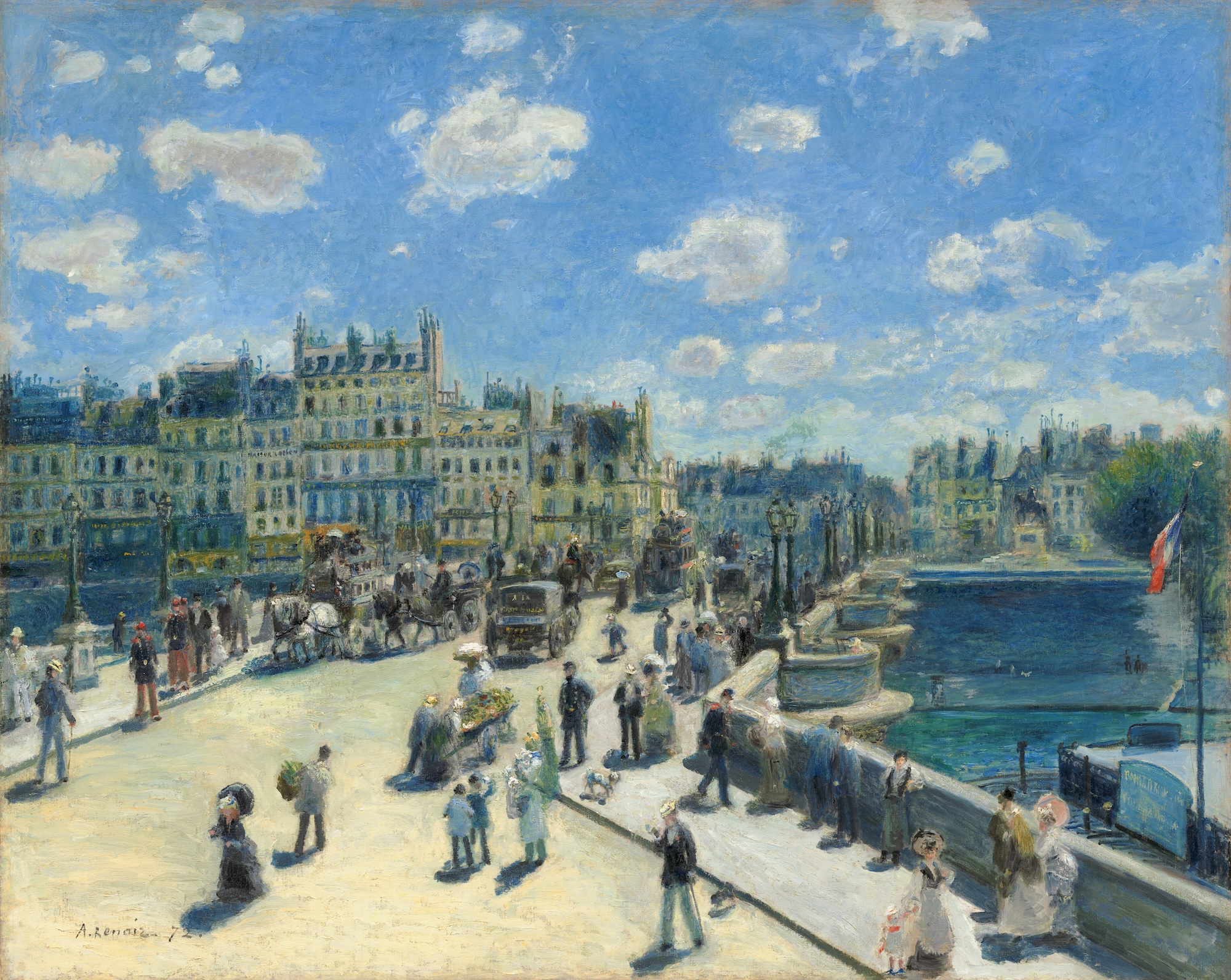
Renoir, Le Pont Neuf, Paris (1872). National Gallery of Art, Washington, DC.
Click image to enlarge.
The letters of the alphabet have long been thought of as highly significant. Some ancient Greek philosophers considered them the building blocks of reality. Islam used them in magical practices. In early Christianity, Christ’s name was signified by a variety of letter combinations, such as I-X or X-P, and early medieval readers believed even the shape of letters conveyed meaning.1 In a long tradition too, Western artists have created scenes that contain disguised letters, as this scene by Renoir helps demonstrate.2
Click next thumbnail to continue

Renoir, Le Pont Neuf, Paris. Detail.
Click image to enlarge.
In this detail from the lower left corner, Renoir’s signature is linked through the line of shadows to two figures, walking in opposite directions. Any idea what they are? Think about it.
Click next thumbnail to continue
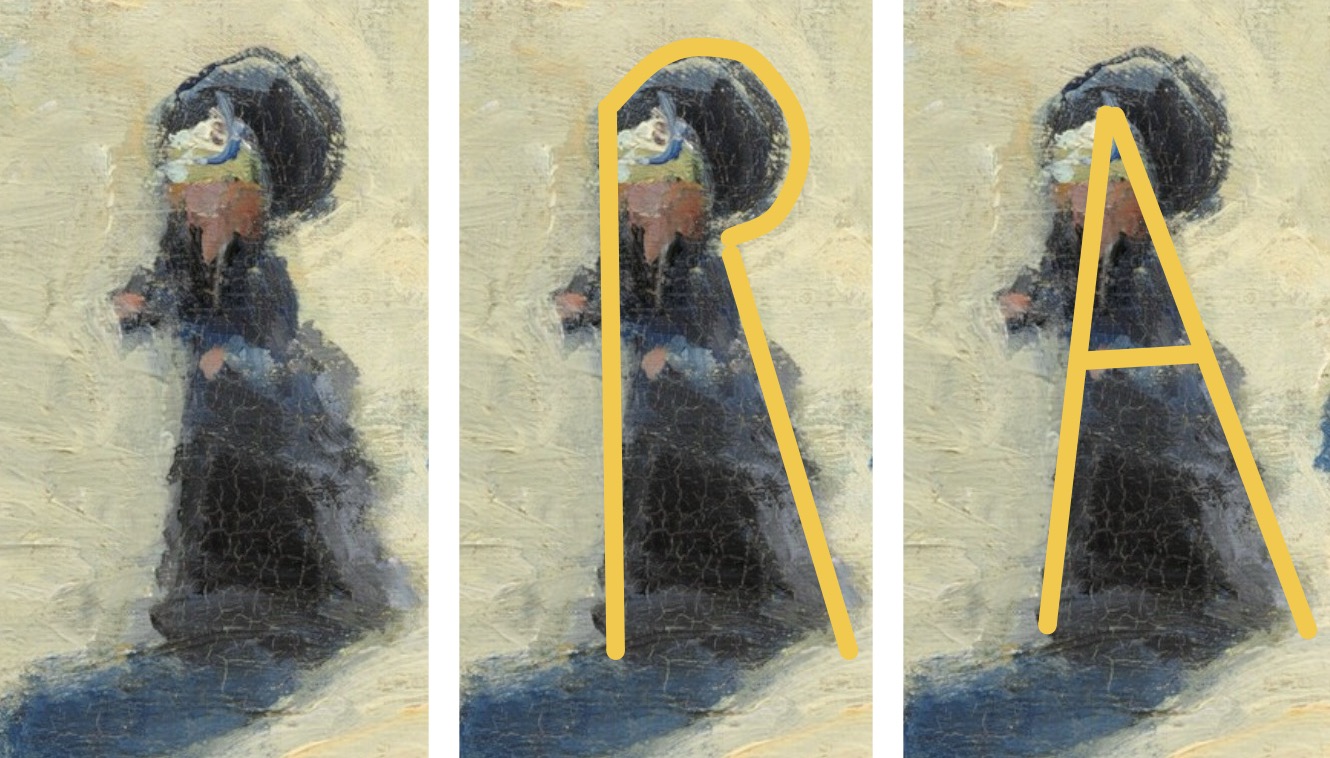
Renoir, Le Pont Neuf, Paris. Detail and diagrams
Click image to enlarge.
The woman with her parasol is an R for Renoir. At the same time, however, her forearm crosses her torso making her an A for Auguste as well.
Click next thumbnail to continue

Renoir, Le Pont Neuf, Paris. Detail and diagrams.
Click image to enlarge.
The man with the basket also forms an A, the edge of his smock as the crossbar. And like her, he is an R as well but this time inverted. It seems to me that the A is theoretically inverted too, but being symmetrical doesn't change.
Click next thumbnail to continue
Renoir, Le Pont Neuf, Paris
Click image to enlarge.
Great artists like Renoir were well aware that major art represents the mirror of the artist's mind, which is how the philosopher Marsilio Ficino had described Renaissance art centuries earlier.3 Thus, Renoir's duplication of his initials and their inversion makes sense. Back to back, the man goes inwards, the woman outwards, just as an artist looks both inwards and outwards. His initials, male and female, signal the androgyny and purity of an artist's mind which, at its best, is universal.4
More Works by Renoir
Notes:
1. Ben C. Tilghman. “The shape of the word: extralinguistic meaning in insular display lettering”, Word & Image 27, No. 3, 2011, pp. 292-308.
2. See entries under the theme Letters in Art.
3. "All the works of art which pertain to vision or hearing proclaim the whole of the artist’s mind [....] Moreover, we can see in them the attitude and the image, as it were, of his mind; for in these works the mind expresses itself not otherwise than (as) a mirror reflects the face of a man who looks into it." Ficino, cited in E. H. Gombrich, "Botticelli's Mythologies: A Study in the Neoplatonic Symbolism of His Circle", Journal of the Warburg and Courtauld Institutes 8, 1945, pp 7-60, esp. p.59.
4. See entries under the theme Androgyny.
Publication Date: 15 Aug 2024
© Simon Abrahams. All articles on this site are the copyright of Simon Abrahams. If you wish to use copyrighted material from this site in print or other media for purposes that go beyond 'fair use', you must obtain permission from the copyright owner. Other websites may link to this page without permission (in fact, please do) but may not reproduce the material on their own site.