A round of cheers for Michael Fried, please!
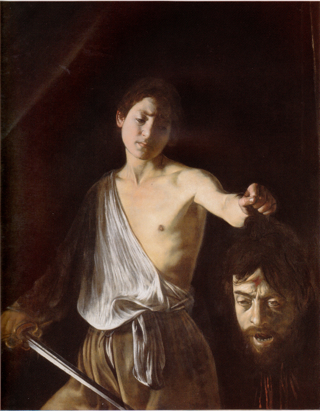
Caravaggio, David with the Head of Goliath (1610)
I have just finished reading Michael Fried’s The Moment of Caravaggio published last year. What a book! A compilation of his A.W. Mellon lectures at the National Gallery of Art in Washington, DC he applies to Caravaggio the same kind of thoughtful analysis that went into his ground-breaking descriptions of Courbet in which he often recognized figures as alter egos of the artist in the act of painting. He rarely recognizes other elements in the image as the painting itself, or other basic features as we do here, but he is one of the few art historians on the same track as us. For instance, I was delighted to find that his interpretation of Caravaggio’s David with the Head of Goliath (above) matches our own almost exactly. This is what he says in recognizing that both David and Goliath are symbols for the artist and his art.
“I interpret David’s gesture…. as a disguised mirror representation of the act of applying paint to canvas, though there is also an important sense in which the head of Goliath may be taken as standing for the painting itself."
Despite his insights, his interpretations are still handicapped by the expectations of other academics and his own training. Not recognizing that every painter paints himself he ascribes those characteristics or, rather, the ones he recognizes to abstract themes such as absorption and theatricality, inwardness and outwardness. He has been using such terms since his first book more than thirty years ago. He knows that he has stumbled onto something important, that others do not see, but without knowing that every painter paints himself he cannot explain it clearly. He does, of course, know the phrase but he may not know of the Inner Tradition and how creative thinkers in all fields have for thousands of years looked inwards for knowledge and wisdom, not outwards. And they have often practiced their beliefs independently and in total secrecy, sometimes welcomed by the Church as St. Francis was, sometimes posthumously as St. Theresa was, sometimes hounded by them as Giordano Bruno was (For more on the Inner Tradition, click here).
Nevertheless, it is very satisfying to know that a major scholar with an international reputation interprets art in the same way we do though he only applies it to the handful of artists he studies in depth, unaware that other artists are doing likewise. For instance, what he sees in Courbet and Caravaggio he failed to see in Manet. Do read his books though. They are well worth it even if his long-winded prose and constant use of the first person irritates at times.
Here are his main books:
Absorption and Theatricality: Painting and Beholder in the Age of Diderot (University of California Press) 1980
Courbet’s Realism (University of Chicago Press) 1990
Manet’s Modernism or, The Face of Painting in the 1860s (University of Chicago Press) 1996
Posted 01 Mar 2011: CaravaggioBooksReligionTheory
The EPPH Blog features issues and commentary.



Reader Comments