Art’s Tradition of Secrecy
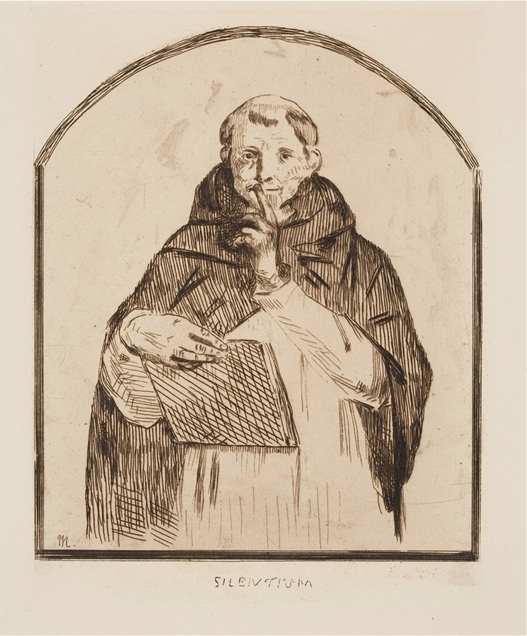
Manet, Silentium (1862-3) Etching on paper.
Great poets are great poets because they have reached heights of spiritual understanding inaccessible to the crowd. The starting-point depends on the individual; some are born prophetic, others somewhere along the way. Those who begin at the bottom, so to speak, are the vast majority of adepts – like you or me, perhaps - but even they represent a tiny percentage of mankind. The rest (99.99%) never even imagine that material reality might be an illusion and that truth must be sought inside. What many of the paths have in common, though, is a warning from one master or another that knowledge of the paths are dangerous to those unequipped and unprepared to hear them. The teachings include within the Christian tradition, for instance, the dawning realization that you can become Christ, that Christ is you. Clearly this is so at odds with church-going Christianity that knowledge of it can be extremely dangerous. The Church fathers and the saints knew that; most priests today probably do not. In the wrong ears, say a young Adolph Hitler’s, the results could be calamitous. Edouard Manet was so aware of this that he etched Fra Angelico’s warning to the monks of the monastery of San Marco, Silentium (above). The message is both silence and secrecy.
I mention this because I was just reading the Prologue to the Cloud of Unknowing, a spiritual tract written by an English monk sometime in the 14th century. It contains advice on how to proceed towards a contemplative life but begins with a similar caution. It is worth reading because The Cloud of Unknowing has ever after been a Christian classic for those striving for spiritual perfection, that state which all great artists achieve on conceiving their greatest masterpieces. It goes like this:
“To you, whoever you are, who may have this book in your possession, whether as owner or custodian, conveyor or borrower: I lay this charge upon you and implore you with all the power and force that the bond of charity can command. You are not to read it yourself or to others, or to copy it; nor are you to allow it so to be read in private or in public or copied willingly and deliberately, insofar as this is possible, except by someone or to someone who, as far as you know, has resolved with steadfast determination, truly and sincerely to be a perfect follower of Christ; and this not only in the active life, but in the contemplative life, at the highest point which a perfect soul in this present life can possibly reach…while it still dwells in this mortal body. He will be one who is doing all that he can…for a long time past, to fit himself for the contemplative life [looking inwards] by the virtues and exercises of the active life. Otherwise this book is not for him.
“….As for the worldly chatterboxes, who brazenly flatter or censure themselves or others, the rumour-mongers, the gossips, the tittle-tattlers and the fault-finders of every sort, I would not want them ever to see this book. It was never my intention to write on these matters for them. I would refuse to have them interfering with it, those clever clerics, or layfolk either. For no matter how excellent they may be in matters pertaining to the active life, my subject is not for them.”1
It seems given how little is known by the wider art world of what I present on this site that those who follow the Muses of the visual arts are as selective with how they convey their knowledge as this anonymous English monk.
1. James Walsh, ed. The Cloud of Unknowing (Mahwah, NJ: Paulist Press) 1981, pp. 101-2
Posted 03 May 2012: Artist as PoetArtist as ChristManetBooksInner TraditionReligionTheory
The EPPH Blog features issues and commentary.



Reader Comments