Beauty is Truth, Truth Beauty
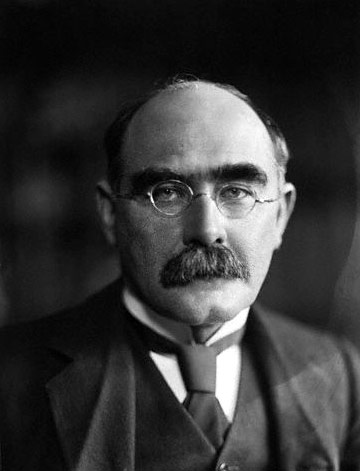
Rudyard Kipling (1865-1936)
I've been reading the Bhagavad Gita, India's gift to the world, and discovering how the themes and principles of good living that Krishna teaches are remarkably similar to those that both Christ and Buddha taught centuries later. No-one knows precisely how old the Gita is but it contains the universal wisdom of mankind. Indeed it is shocking to discover in reading the narrative that the human mind has made no progress in these matters for God-knows-how-many thousands of years. Why is it, then, that we consider ourselves so much wiser?
The Gita encourages its readers to become their own inner divinity just as Christian mysticism, and Thomas à Kempis' Imitation of Christ for example, does too. Albrecht Dürer and other great painters, in posing themselves as God or as Christ, make the same suggestion as long as the viewer is ready for it. If they are, they will perceive the hidden meaning on their own.
The Mahabharatha, the book-length poem inside which the Gita is contained, has been called "a literary masterpiece about the depths and heights of the human soul." So has Dante's Commedia, the guiding text of the Italian Renaissance. Jack Hawley who has lived with the Gita for decades calls it a manual on how to remove pain and sorrow from your life while facing death with equanimity. I don't want to make this too complicated but among its prescriptions is to live life in an emotional balance, a state in which you treat both success and failure with some detachment.
That made me think of If…, the celebrated poem of Rudyard Kipling in which he makes similar recommendations to his son. Kipling, of course, was born in India. His deep familiarity with the Gita seems to have led directly to the advice he proffers in If…, how to keep your head when all about you are losing theirs, how to be modest and humble and treat others with the same respect you would expect them to treat you. There is no need to go on because Kipling says it better than I ever could. The poem is included below for those unfamiliar with it or those wanting to read it again.
Just consider while you read it that it is not Kipling's way with words that makes the poem so beautiful, any more than an artist's way with brushstrokes makes a painting beautiful. No, what makes beauty beautiful is timeless and transcendent wisdom thus, as a result of If...'s truth, Kipling's words sing. That is why I have little time for art criticism that focusses on style, composition and technical matters. Paint alone is not beautiful. This may be more difficult to visualize in art than in literature because we are not used to reading forms in the same way we read words. Nevertheless, no amount of technical facility with a brush will make a painting beautiful unless it contains the same kind of truth and wisdom that makes a poem immortal.
That's what another poet, John Keats. tried to say in the words I used for the title to this blog entry. Here, though is Kipling's poem:
IF you can keep your head when all about you
Are losing theirs and blaming it on you,
If you can trust yourself when all men doubt you,
But make allowance for their doubting too;
If you can wait and not be tired by waiting,
Or being lied about, don't deal in lies,
Or being hated, don't give way to hating,
And yet don't look too good, nor talk too wise:
If you can dream - and not make dreams your master;
If you can think - and not make thoughts your aim;
If you can meet with Triumph and Disaster
And treat those two impostors just the same;
If you can bear to hear the truth you've spoken
Twisted by knaves to make a trap for fools,
Or watch the things you gave your life to, broken,
And stoop and build 'em up with worn-out tools:
If you can make one heap of all your winnings
And risk it on one turn of pitch-and-toss,
And lose, and start again at your beginnings
And never breathe a word about your loss;
If you can force your heart and nerve and sinew
To serve your turn long after they are gone,
And so hold on when there is nothing in you
Except the Will which says to them: 'Hold on!'
If you can talk with crowds and keep your virtue,
' Or walk with Kings - nor lose the common touch,
if neither foes nor loving friends can hurt you,
If all men count with you, but none too much;
If you can fill the unforgiving minute
With sixty seconds' worth of distance run,
Yours is the Earth and everything that's in it,
And - which is more - you'll be a Man, my son!
Posted 04 Aug 2012: Artist as ChristDivine ArtistBooksTheoryVisual PerceptionWriters
The EPPH Blog features issues and commentary.



Reader Comments