Bronzino’s Ginger Hair
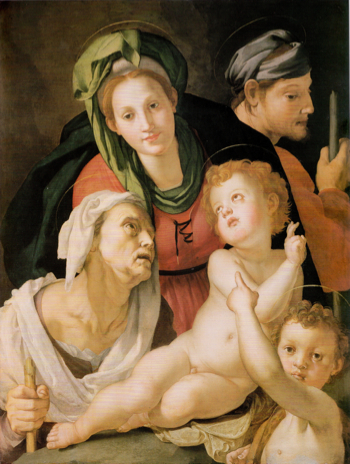
Bronzino, Holy Family with St. Elizabeth and St. John (1526-8)
No-one knows how Agnolo di Cosimo gained his nickname, Bronzino, but the general view seems to be, without any evidence, that he may have had a dark complexion. Yet how about the color of his hair? A portrait of Bronzino by an unknown painter shows him with red hair while that in his own self-portrait as the biblical King David might conceivably be described as “bronze”.1 Even if his name derives from elsewhere, why do so many of his figures have red hair? Not just in one or two instances but sometimes a dozen or more figures in a single work. In Christ’s Descent into Limbo at least 15 of both the damned and saved have ginger hair including Christ. Everyone’s hair is spiced red in a picture of the Holy Family from 30 years earlier save the elderly Elizabeth whose glimpse of grayness has a reddish tinge (above).
Unbelievably, for an artist praised for his truth to nature, 76 of the principal figures in this current exhibition of paintings in Florence have red hair. Only 18 of them do not and several of those are gray or bald. Both of the Panciatichi, husband and wife, have bright red hair, a combination I have never seen in couples. Art historians seem to find nothing odd in this. No mention is made of it in the current catalogue yet it seems very possible that Bronzino was using red hair as his personal emblem.2 It demonstrates, yet again, that every figure is an aspect of the artist’s own mind, a way of seeing that conventional viewers find troubling in scenes of the Holy Family. Yet, as explained under the theme, The Inner Tradition, most mystics, saints, poets and artists did not follow the Establishment line, that God is outside us directing the cosmos like Zeus. They found that view unbelievable. What their minds know, on the other hand, through profound personal experience is that God (or whatever, creative life force you choose to call it) is inside us. “I am God”, Bronzino is saying when the flame of Christ’s hair strikes your eye. Meister Eckhart and many other mystics said the same. Divinity is inside you and if you seek peace in this turbulent world you need to rediscover that God-like spark, lost or hidden within your own nature. Bronzino’s art, like all art on its deepest level, is a self-help guide for lost souls.
As for his method, changing hair color to match the artist’s is not unique to Bronzino. I have shown elsewhere how Daniel Mijtens painted England’s King Charles I with dark brown hair while Van Dyck painted the same king around the same time with a red beard as vibrant as his own. Both Manet and Matisse used their blond and red hair, respectively, to identify their alter ego while, in late twentieth-century America, Andy Warhol often changed the color of his sitters’ hair even in commissioned portraits.3 Bronzino, whatever the origin of his name, was sending a message in all that red hair that we, the viewer, need to be alert to. It means something.
1. The anonymous portrait of Bronzino is in The Uffizi, Florence.
2. Bronzino: Artist and Poet at the Court of the Medici (Florence: Palazzo Strozzi) 2010
3. Warhol: La Grande Monde d’Andy Warhol (Paris: Grand Palais) 2009, p. 285
Posted 19 Nov 2010: BronzinoManetMatisseMijtens, DanielVan DyckWarholExhibitionsVisual Perception
The EPPH Blog features issues and commentary.



Reader Comments