Leo Steinberg and Christ’s Organ
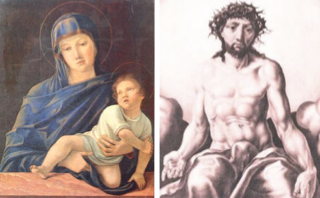
Left: Giovanni Bellini, Virgin and Child (c.1500)
Right: Maarten van Heemskerck, Detail of Ecce Homo (c.1525)
Leo Steinberg died two days ago in New York City at the age of 90. He was an art historian who wrote English clearly and had an unusual eye. His most important contribution was not, as is generally believed, his book Other Criteria in which he coined the phrase the “flat-bed picture plane” to describe the post-war work of Jackson Pollock, Jasper Johns, Picasso and others. As users of this site should know, art is primarily about meaning, not style, so if the picture plane is flat it must mean something. Nor was his celebrated two-part article on Picasso’s Les Demoiselles d’Avignon, “The Philosophical Brothel”, particularly interesting either. What he should be remembered for, work that is already being forgotten by other art scholars, is his remarkable article and then book, "The Sexuality of Christ in Renaissance Art and in Modern Oblivion."
In both versions he demonstrated in dozens of examples that painters in the Renaissance were fixated on Christ’s genitals. The Magi peer at them, the Virgin fondles them (above left) and sometimes Christ even gets an erection (above right). No art historian ever noted this before Steinberg. Unfortunately he came to the wrong conclusion. He argued that the focus on Christ’s private parts was intended to emphasize Christ’s humanity, an eminently sensible idea but rather lame. Does that really explain Christ’s erection? I doubt it. What he discovered has more to do with how artists use visual metaphors for describing how divinity works in their own minds to power their creative spirit. But I’m getting ahead of myself. In the coming months I will explain how artists identify with Christ at every moment of His life because Christ's life represents their own spiritual journey and ours too. More about that later. Now it’s a good time for other art historians to dust off their copies of Steinberg's book and refresh their memories because when the dust settles, he should be remembered for this.
The EPPH Blog features issues and commentary.



Reader Comments
Christ’s erection is a symbol of regenerative power.
Every God should be able to resurrect or restore his fertility.
Look at Egypt Even the sarcophagus had holes in it to display the prominent post-mortal erection. Visible in Leiden NL.
The creator was the phallus trough all centuries.
So resurrection means erection.
Even erect stones present the same idea.
That’s why Pillars point to an erection, even candles do.
Or the needle before the Vatican.
BRNRDS
14 Nov 2014
Brnrds
That’s an apt comment with very useful and interesting examples.
Many thanks, Simon
Simon
14 Nov 2014