Proust’s and Degas’ Disappearing Models
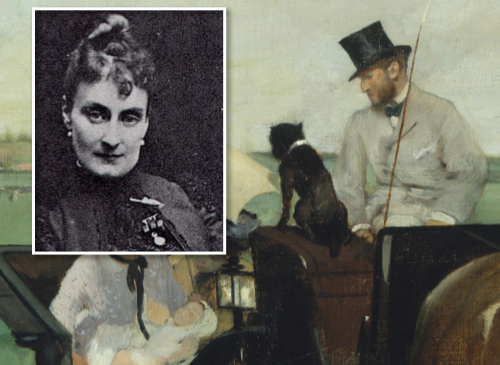
Degas, At the Races in the Countryside, a detail (1869) Oil on canvas. Museum of Fine Arts, Boston.
Inset: Anon., Portrait of the comtesse de Chevigné Photograph
Literature and its methods are a useful yardstick by which to judge our knowledge and understanding of the visual arts. For instance, the known fact accepted by literary critics that many friends and acquaintances of Marcel Proust, the great French writer of the early 20th century, thought they had come across a portrait of themselves in his seven-volume A la recherche du temps perdu (1909-1922) has had little impact on art history. Nevertheless the search for the models behind Proust’s characters remains a popular pastime. The names and titles of these prominent people were changed, of course, in Proust’s fiction and sometimes their roles in society but, still, those people who knew Proust well felt a resemblance. Camille Barrère, a diplomat and friend of the writer's parents, became enraged when he saw similarities between himself and the pompous marquis de Norpois. The comtesse de Chevigné (above, inset) was originally quite flattered to be the model for one of Proust’s most important characters, the duchesse de Guermantes, but was horrified later when Proust described her birdlike features. In many cases, of course, Proust’s characters were a composite of several people. The method’s importance to Proust's craft and his intentional use of it is evident in some of his earliest work.
In 1892, in one of his first pieces of prose titled Esquisse d’après Mme.*** (Sketches after Mme.***), Proust gave the main character the avian features of the comtesse de Chevigné which she was unaware of at the time. When he republished it in 1896 along with the sketch of another character he titled the two together Cires Perdues (or Lost Wax). The title refers, of course, to a step in the process of casting bronze sculpture in which the original model is made from wax, coated in plaster and then heated to melt the wax leaving an impression of the original (and final) sculpture in the hollow of the plaster. In heating it, however - and this is Proust’s subtle but revealing pun on his literary method – the wax melts and the original figure (in this case, the comtesse de Chevigné) is lost.1
I believe the same has happened to thousands of figures in art history including, for example, the driver of Degas’ horse-drawn tilbury above. A new entry on this masterpiece, At the Races in the Countryside (1869) will be published this week.
1. Keller's essay is more to do with Proust than Degas but is important for Degas studies nonetheless. Not mentioned above is his insight, supported by other writers in the same catalogue, that many of Degas' portraits share the same facial features. Luzius Keller, "Portraiture between Tradition and Avantgarde: Proust and Degas" in Degas Portraits (Zurich: Kunsthaus) 1995, p. 129
Posted 09 Mar 2013: Artist as PoetBaconDegasBooksPortraitureTheoryVisual PerceptionWriters
The EPPH Blog features issues and commentary.



Reader Comments