Recent Reading
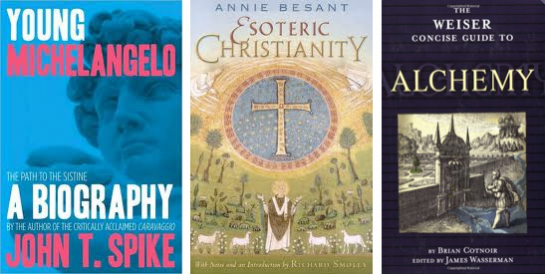
If anyone noticed the reduced activity on the site over the past ten days, forgive me. I was on a beach where, in between downpours, I got the chance to catch up on some reading. Three books in particular are worth recommending:
John Spike’s Young Michelangelo is an innovative biography of his early years. Using the newly transcribed ledgers of Michelangelo’s bank accounts in Florence and Rome to cross-check Michelangelo’s own later recollections of his life, Spike provides a compelling account of the great man’s day-to-day activities. Like many great artists, Michelangelo was intensely focussed on increasing his wealth, far more than he ever admitted. This book is likely to become a standard reference for the early period of Michelangelo’s life in much the same way that John Richardson’s multi-volume biography does for Picasso. Though necessarily less colorful than Richardson’s narrative – based clearly on a far smaller amount of documents and recollections – Young Michelangelo is still rewarding reading. Spike’s interpretations of the great man’s works, though, are less useful than the historical narrative. Though he claims, for instance, that the Vatican Pietá “was Michelangelo’s contribution to mystical Christianity”, he shows little understanding of that grand tradition in which there is a Christ in each of us. If he had, he would have recognized Michelangelo’s identification with both the Virgin and Christ. So, go to Spike for the history; come back here, to EPPH, for the interpretations.
Next on the list is a reprinted classic from 1905: Annie Besant’s Esoteric Christianity (republished by Quest Books, 2006). This is the book Spike should have read before ascribing the Pietá to Michelangelo’s mysticism. In it Besant, a gifted writer, recounts in clear and compelling prose the story of how, against all the odds, the flame of the Christian Mysteries was never doused but handed down by individuals and in small groups century after century. For those unclear about how the Inner Tradition works within Christianity, there is no better choice than Besant. This book will open your eyes to dozens of masterpieces though art itself is mentioned only once. When you hear how Origen and the earliest Church fathers warned that the incredulous tales in Scripture were written so as to alert intelligent readers that there was another meaning under the exoteric one, you will see the same in all forms of the visual arts. Not everyone is suited, though, to understand and appreciate an allegorical reading, let alone the Mysteries, so an exoteric or surface story is necessary in Scripture (and, I should add, in art) to entertain the less gifted with stories of faith. Her description of the mystics’ coded language is particularly rich, allowing us to make sense of some of the New Testament’s strangest claims. The Mysteries, for instance, were referred to with secret names such as “the Kingdom of Heaven”, “The Narrow Path”, “The Strait Gate” and “The Second Birth.” Thus, when the Bible tells us that it is easier for a camel (an old mistranslation for a rope) to pass through the eye of a needle than for a rich man to enter the Kingdom of Heaven, it does not literally mean Heaven. If it it did, it would be contrary to Christianity’s basic principles. Everyone is forgiven; rich men too. What the story really means, is that you cannot become an Initiate into the Mysteries (“the Kingdom of Heaven”) until both exterior and inner possessions have been sacrificed. The truth is there really is no heaven and hell to choose from after life because, in death, we are all at one with God. Get the book. It will blow your mind.
The third book is a slim but remarkable volume: Brian Cotnoir’s The Weiser Concise Guide to Alchemy, published by Weiser Books in 2006. Cotnoir summarizes alchemy’s basic concepts and, in the first half, makes simple sense of a very complex subject. It’s important to read because so many artists from the Renaissance through the seventeenth century were familiar with alchemy; and again in the twentieth. Besides, alchemy has appeared in many cultures at many different times. Both Marcel Duchamp and Joseph Cornell were familiar with alchemy and made use of it in their art. Cotnoir’s explanation of the underlying theory is particularly good, as are the comparisons he makes to art and poetry. His explanation of how the transmutation of base metals into gold reflects the inner state of the alchemist will help the reader understand how “the inner development of the alchemist is one of the fundamental keys to the process” as the artist's is in art. The books’ second half, written for the practising alchemist (yes, some still do practise), can be skipped by all except the committed. The first third of the book alone though is worth twice the price of the whole.
Posted 15 Feb 2011: MichelangeloBooksReligion
The EPPH Blog features issues and commentary.



Reader Comments