Veiled Faces
This may be the most controversial suggestion because it has been proposed by many lay experts before and denounced by the academics every time as foolish and mistaken. Certainly, there have been some outlandish claims but to dismiss all of them, some of them highly important, is equally foolish. This is the truth: under the apparent surface of many great paintings, especially landscapes, is a hidden face. Sometimes it is the artist’s, sometimes an admired poet’s or, as in most instances, still anonymous. Academics comment in disagreement “that you can see what you want to see” but the self-evident examples shown here make that response untenable. Practising artists, however, when shown these examples have unanimously agreed with our perception, many with comments like “That’s how an artist thinks.”
All Articles (Alphabetical by Artist, then Title)
The Inner Tradition as practised by a Catholic artist....
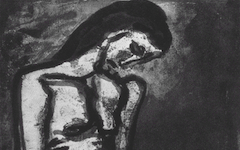
Rouault’s Miserere: Eternally Scourged (1922)
See how Rubens' own face is veiled behind a drawing of a forest path
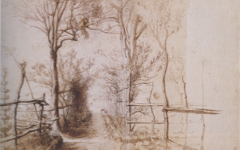
Rubens’ Forest Path (n.d.), a drawing
All art depicts the artist's mind. Here's one way you can see it.
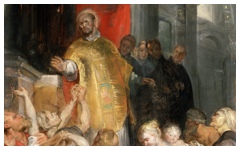
Rubens’ Miracles of St. Ignatius of Loyola (c.1619)
In photographs taken with a macro lens, showing an object in extreme close-up, it can be difficult to recognize the subject. It is the same in painting. However, if you know it's a close-up, it's easier.
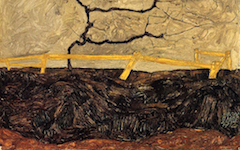
Schiele’s Bare Tree Behind a Fence (1912)
Don't take portraits at face value. If they're art, there's always more to them.
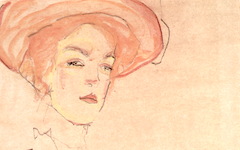
Schiele’s Portrait of a Lady in an Orange Hat (1910)
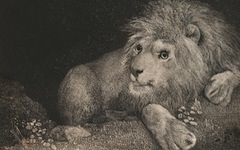
Yet another visual illusion that has never been published.
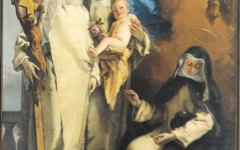
Tiepolo’s Virgin Appearing to St. Catherine… (1748)
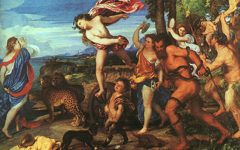
Even in the remaining fragment of a much larger canvas there is still much to see
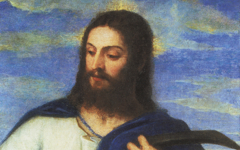
Titian’s Noli Me Tangere fragment (1553-4)
Relax. Look past the superficial forms to see what's really there.
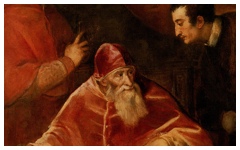
Titian’s Pope Paul III and His Grandsons (1545-6)
A much-loved painting contains a marvelous self-portrait in the clouds
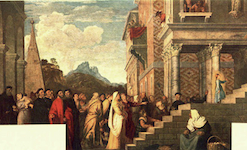
Titian’s Presentation of the Virgin in the Temple (1534-38)
Get to know what painters and sculptors look like at work - and their various processes - and your brain will penetrate the surface of a painting in no time. A painting like this one...
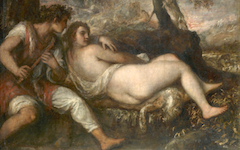
Titian’s Shepherd and Nymph (c.1575-6)
Turner's landscapes with distant views are based, in turn, on close-ups of his own face

Turner’s The Fifth Plague of Egypt (1800)
Whatever the reasons for his style, Van Gogh made full use of the distortions
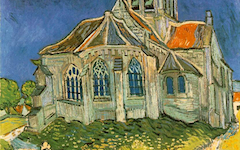
Van Gogh’s Church in Auvers-sur-Oise (1890)
Van Gogh is one of the few artists whose hidden elements revealed on EPPH confirm the conventional view of his art.
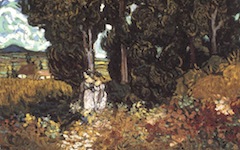
Van Gogh’s Cypresses with Two Female Figures (1889)
Landscapes, if art, are never just landscapes. Are they even landscapes? The Chinese call them "Mindscapes"
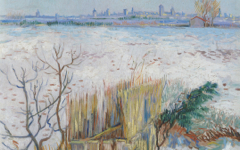
Van Gogh’s Snowy Landscape with Arles in the Background (1888)
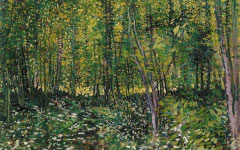
How Van Gogh turned a self-portrait into an iconic landscape
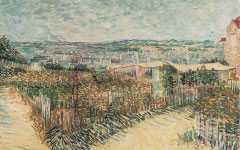
Van Gogh’s Vegetable Gardens at Montmartre (1887)
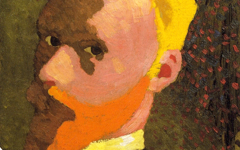
Artists often identify with other artists, using them as an alter ego. Here is an exceptionally clever one.
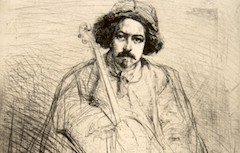
Whistler’s J. Becquet, Sculptor (1859)
© Simon Abrahams. Articles on this site are the copyright of Simon Abrahams. To use copyrighted material in print or other media for purposes beyond 'fair use', you must obtain permission from the copyright owner. Websites may link to this page without permission (please do) but may not reproduce the material on their own site without crediting Simon Abrahams and EPPH.