02 Dec 2014 | 11 Comments
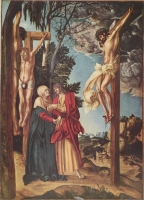
Your Go: Explain this picture!
OK, readers, this a chance to practice your own powers of perception and interpretation before I comment:
Explain below what this Crucifixion scene might mean and the oddity of Christ’s loincloth. I am drawing attention to that
20 Nov 2014
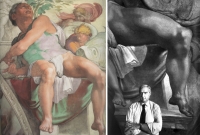
Actual size of Michelangelo’s figures
How large are Michelangelo's figures on the Sistine ceiling? Visitors find it difficult to tell from the chapel floor because they are so far away. It was not until I saw the photograph at right that I realized their true size. Jonah's thigh is
08 Nov 2014
3 Practical Ways to Understand Art
How can museum visitors and art lovers interpret art for themselves without having the specialized knowledge of experts? It is easier than you think and within the grasp of many. The key is not in books but experience. And that would have been tru
30 Oct 2014
An Artist’s Path to Certainty
How does a great artist know he is on the right track before being recognized as canonical? Van Gogh, for example, knew his own importance despite commercial and critical failure; Picasso was convinced at a very young age. The answer, I believe,

23 Oct 2014
The Male Artist and His Female Muse
Mona Lisa was Leonardo’s muse and he kept the portrait with him until his death. The beautiful, semi-nude La Fornarina was Raphael’s. Titian’s muse and Palma Vecchio’s are both called Beautiful or La Bella in Italian. Parmigianino’s is
17 Oct 2014
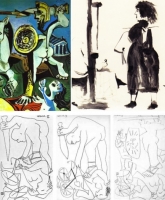
Brushing up on the Painter’s Sword
The mind of an artist is poetic so, if you want to understand painting and sculpture, read poets. Their literary metaphors are the artist’s visual ones. However, beware: poets understand visual art no better than most people. Emile Zola, Charl
24 Sep 2014 | 2 Comments
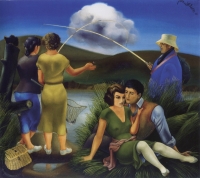
Reading Art: Manet, Picasso and Alfonso Ponce de Leon
My vision, like most people’s, is often cloudy which is why when the sun breaks and I gain some understanding, I get excited. You must excuse me. It may sometimes seem as if no-one before me has made similar observations. After all, all my ent
03 Sep 2014 | 1 Comments
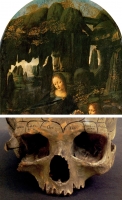
Leonardo’s Skull Rocks
Art is visual which means, contrary to a lot of theoretical discourse, so are its secrets. And if you train your eyes to search for similarity rather than difference, you'll be amazed at what you can discover.
Few paintings have b
20 Aug 2014
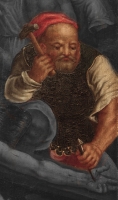
The Craftsman’s Christ
This is a scene by an unknown 16th-century artist, probably Flemish, at a time when artisanal effort was admired not just for the perfection of the end-product but for the artisan’s closely-guarded knowledge of materials. Wood, stone, minerals,
23 Jul 2014
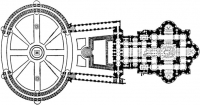
Key to Meaning in Architecture
Symbols, as explained here about painting and sculpture, can be concealed at many levels, some so deeply that only initiates would notice them. Who other than an architect could possibly have seen what Bernini did to St. Peter’s in Rome w
19 Jul 2014 | 1 Comments
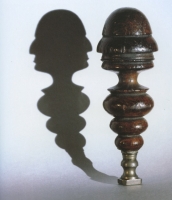
How many features does a face need?
How much information do we need to recognize a face? Astonishingly little. Here George Washington’s can be recognized in the handle of a wooden seal (c.1810). This explains, perhaps, how artists can continuously convey their features in other

17 Jul 2014 | 1 Comments
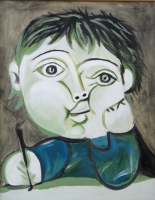
Bacon’s Frank about Portraiture
Occasionally an artist's recorded thoughts give hints that their views on portraiture are not conventional. I have quite a collection of them. However someone just sent me this 1971 statement by Francis Bacon in which he completely rejects
13 Jul 2014 | 4 Comments
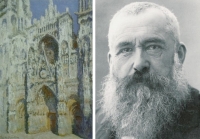
What users are saying about EPPH
EPPH gets all sorts of readers yet of those who return, there is a definite type. How do we know? The vast majority of comments are complimentary (96%); many of you seem to respond in the same way and you are quite likely to be an artist too. Th
25 Jun 2014 | 2 Comments
Is self-representation self-centered?
(On vacation. A re-post from last summer)
The practical and philosophical issue of whether figures in art depict the artist or the apparent character is well expressed by two different translations of the same text in a Upanishad. The p

26 May 2014 | 1 Comments
Magic from Matisse and Michelangelo
What does Matisse’s figure from Dance II (1910) have to do with Michelangelo’s St Peter from the Last Judgment (1534-41). More than you might think. Bear with me. Both are nude against a blue sky, facing us and facing left; both look a littl
13 May 2014
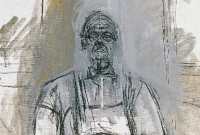
Giacometti on his Sitters’ Inner Being
So much of the poetic method in art remains a closely-held secret. Like initiates in a mystery religion, great artists have long had a common understanding that what they prize in their creative process should not be shared with the unappreciati
08 May 2014
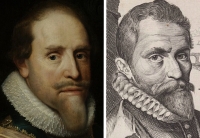
Dutch Royals Are Artists
I received a message from the Rijksmuseum that their superlative site, the Rijkstudio, now has a collection of Dutch royal portraits. Anyone who has seen on EPPH how portraits of British, Italian and French royalty resemble the artist might wonder
17 Apr 2014
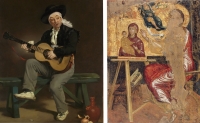
Manet’s Spanish Singer Raises a Leg
Inspiration can come from anywhere so it's a good idea to look at the art of all periods. Artists do so, no matter which century they live in. A few days ago I solved one of my long-standing problems with a picture by the19th-century artist Edou
14 Apr 2014
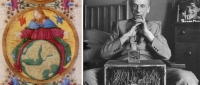
Joseph Cornell gives birth to a box…
Birthing, physical birth, is one of poetry and art’s most powerful metaphors used for many centuries, perhaps ever since art first appeared. It plays on the relationship between sexual conception and mental conception while often conveying that

13 Apr 2014
The Artist is Always Present
Very few novels use the first person pronoun, most using an impersonal narrator to describe the scene. The author David Henry Thoreau noted that, with the ‘I’ omitted, the reader forgets that it really remains there because the novelist is c

13 Mar 2014
Flat Noses on a Frontal Face
A year ago I used this early portrait drawing by Ingres (left) to demonstrate that Picasso's combination of faces from differing viewpoints, a hallmark of Cubism, was a technique practiced by earlier artists for a similar reason. Ingres, for ins
03 Mar 2014
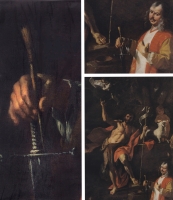
The Brush-Sword of Mattia Preti
After the recent post on a new book of cartoons, Daggers Drawn, this one is on the same subject 350 years earlier.
Mattia Preti (1613-1699) was a major Italian artist who is little-known because he spent much of his life on the islan
25 Feb 2014
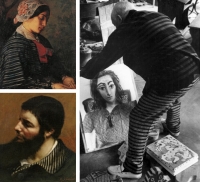
Picasso-as-Courbet
Many great artists I follow use a feature other than the face to identify themselves in pictures that are not self-portraits. Given that all their figures represent the artist, they need a variety of methods to hide and reveal their self-referen
23 Feb 2014
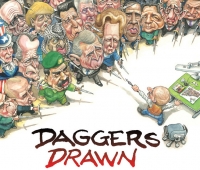
Daggers Drawn
Daggers Drawn. A new compendium of a political cartoonist’s 35 years in the business and on the cover he stands at his desk, pen drawn, facing the dictators and democrats he has followed, all with daggers drawn too. The conclusion is simple to
16 Feb 2014
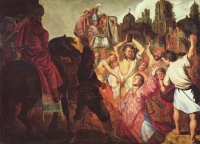
Is Stoning Stephen Grinding Colors?
In the wider world of art history where the word "art" has not been properly defined, the search for meaning is more complex and difficult than it is here. If biologists studied different types of trees without agreeing on what a tree was, they to
10 Feb 2014
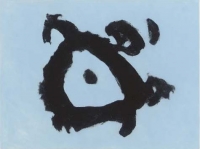
The Poet’s Eye
What you see may not be all you see because somewhere inside most true artworks one form is laid over another. Here's a simple example from a print made by Robert Motherwell (1915-1991), a leader of the New York School in the mid-twentieth century
04 Feb 2014
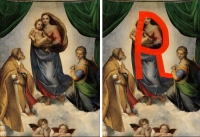
A Musical Note and Letters
It's a red-letter day for Raphael. I have been showing a lot of letters recently, how Raphael and Renoir each used objects shaped like an R, how Manet and Matisse used M’s and Ingres used an I. And I doubt before this evening that anyone has e
22 Jan 2014 | 2 Comments
What’s Wrong with the Art World?
What is wrong with the art world? Why can't they see Van Gogh's self-portrait in the fireplace (above)? It is so obvious that a child would recognize it if shown. Whatever the reason, no expert can. That means that this colorful and late self-po
15 Dec 2013
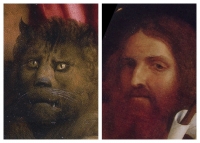
Lotto’s Lion and The Mystical Marriage of St. Catherine
After the recent post about how Sir Edwin Landseer became a couple of dogs (seriously), I thought it would be a good idea to keep up the pace and show how Lorenzo Lotto became a lion. Near the lower edge of one of his greatest masterpieces, The
14 Dec 2013
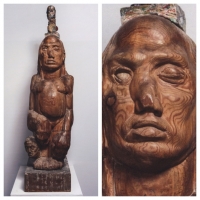
Winking in Art
Russian artists in the early 20th century turned to the West to absorb the latest trends happening in Paris. That’s the conventional story. Yet, little known, at the same time they were also turning eastwards towards Siberia and Russia’s ori
The EPPH Blog features issues and commentary.