24 Nov 2013
How a Dumb Skull Spoke
The difference between my method of looking at art and the conventional one is, in essence, quite simple: I spot-the-same while most others spot-the-difference. I notice this all the time which is why a recent advance in paleontology also caught

20 Nov 2013
Picasso Hid a Sword in Nazi Loot
Sometimes I do no work at all. Things just pop in my face. I suppose I'm so used to looking for certain features that my eyes know what to look for subconsciously. That's what appeared to happen last week as I read the news that the Germans

18 Nov 2013
Giacometti’s Visual Illusion Blows My Mind
Yesterday, after posting the entry on Giacometti’s Self-portrait with Brush (above), I saw something astonishing. It's a good reminder that even when you think you understand, there's still more to know. And it comes with perserverance and the

04 Nov 2013
Do artists still keep secrets?
Is there, as EPPH proposes, a secret tradition, handed down in virtual silence over many centuries, from one artist to another but which is still completely unknown to art historians? I admit that seems unlikely and though I have revealed it in

31 Oct 2013
A Sioux Story on Creation
Every painter paints himself is not just an expression of a poetic method but an insight into the nature of reality. That’s why it’s so important. You can only see in front of you what you already know or feel inside you. Thus, we too p

14 Oct 2013
The Error of Art History
Yesterday I wrote about how some errors make the world interesting and beautiful. This one does not.
Read the Journals of Ralph Waldo Emerson, who rarely saw great art, and you will learn about it on every page because the truths

13 Oct 2013
Higgs Boson and Mistakes
So, not long after the discovery of the Higgs boson and half a century after they predicted its existence, Higgs and Englert win the Nobel Prize in Physics. I don't often relate to advances in science but this one's a biggie. Last year, on news

02 Oct 2013
Blindness Lets People See
"The blind can see" sounds like a biblical myth but it is true. The blind and the visually impaired can see visual art for what it is, at least the idea of it, while the sighted generally cannot. In paintings and sculptures over many centuries,

28 Sep 2013
How Manet and other artists shoot their paintings
Have you ever shot your mother? Directors shoot movies and nearly everyone has made a snap-shot with a camera but few imagine that artists shoot paintings. In fact they have shot nearly every canvas with a gun in it since the devilish implements

18 Sep 2013
A Hair-raising Tool to Understand Art
It's interesting to learn something new about an artwork but even more exhilarating to learn the craft itself by acquiring the mental tools used to interpret what few can see. We all paint the world the way we think it or are told to think it by

10 Aug 2013 | 2 Comments
Soak it up! The Story of Degas’ Sponge.
Degas was a well-known miser so some people might still think of him as a sponge. That would be appropriate. Artists don't always handle brushes; they use anything that works, sponges included. A selection sold for use by artists is il

22 Jul 2013
The Imaginative Advantages of Self-Deception
"A serious human life….can hardly begin until we see an element of illusion in what is really there and something real in fantasies about what might be there instead." Northrop Frye (1912-1991)1
Frye, a well-known literary critic (abo

14 Jul 2013
Resemblance in an Animated Face
Can two quite different faces each resemble the artist? The answer is yes, because the visual processes of the brain do not need to see similarity in all features. Your visual cortex is clever and can color in what you cannot see or have not see

13 Jul 2013
Hockney Draws Rain or Shine
When an artist paints a subject, what is most likely to dominate their thoughts: the subject, the process of creating it or both? Well, you all know the answer to that one. Still, it was sweet to read David Hockney confirm it while discussing

05 Jul 2013 | 3 Comments
Art’s Etymology
The successful Germans are not very popular at the moment in France, Italy and Great Britain, all suffering economically. But who do you think understands art better? Well, if language is anything to go by, it's not the Romance languages an

21 May 2013
Plays on the Mind
The Wall Street Journal recently reported that Richard Foreman, an experimental playwright for more than four decades "has presided over heady spectacles that mingle the conventions of theater with ... stroboscopic stage sets designed as embodim

20 Apr 2013
Do you know what it means to come home?
Think differently. The old ways are often dull and didactic. Take, for instance, paintings and prints that seem to illustrate Bible stories. Why treat them as a narrative when mystical Christians, among whom must be counted many great Western ar
12 Apr 2013 | 7 Comments
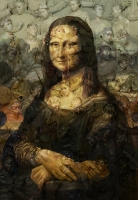
How a Scientist Solved the Puzzle of the Mona Lisa
The true identity of Leonardo's Mona Lisa has been a long-running mystery captivating generations of art lovers and scholars. Yet the most crucial piece of information about the Mona Lisa missing from standard textbooks is that the proportions o
10 Apr 2013 | 1 Comments
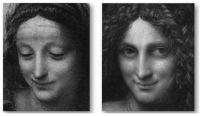
Leonardo’s Facial Mystery
The discovery that great portraits do not depict identifiable people, as long believed, is a real eye-opener. (See the book free online titled Every Painter Paints Himself.) Yet the significance of what you can now see in portraiture can only be
03 Apr 2013 | 3 Comments
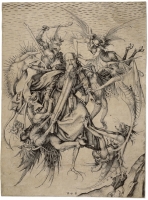
Art as a Spiritual Guidebook
Some readers may wonder - not many, I hope - how and why I describe so many different figures in art, from the Middle Ages to Picasso, as yet another representation of the artist. It can seem repetitive and boring, even simplistic. Yet it is a b
20 Mar 2013 | 2 Comments
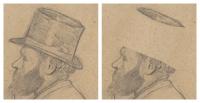
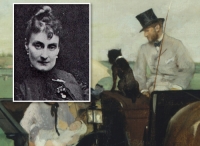
How Degas drew a top hat…
Art is so pregnant that even in a "simple" sketch like Degas' Edouard Manet at the Races (c. 1865) there is always something more. I thought I had drained the drawing when I finished writing about it yesterday (see entry). And, then, this m
09 Mar 2013
Proust’s and Degas’ Disappearing Models
Literature and its methods are a useful yardstick by which to judge our knowledge and understanding of the visual arts. For instance, the known fact accepted by literary critics that many friends and acquaintances of Marcel Proust, the great Fre
18 Feb 2013
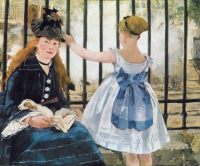
1+1=1: The Divided Self in Manet’s Railway
What is the girl up to? Who are they? What's happening? Why do they wear the same color clothes? Why is the girl's hair so odd?
In my explanation two years ago of Edouard Manet’s The Railway (1873) I noted that the extended arm of the

02 Feb 2013 | 15 Comments
Roy Lichtenstein’s Plagiarism
Plagiarize! Plagiarize! Let no-one else's work evade your eyes! Remember why the good Lord made your eyes, So don't shade your eyes, But plagiarize, plagiarize, plagiarize.....
Tom Lehrer's comical lyrics from the 1950's were pierced

29 Jan 2013 | 5 Comments
2nd Self-Portrait Found in Same Met Gallery!
After discovering a self-portrait by Picasso four days ago (see blog), I think I've discovered another one, this time by Bonnard.....hanging right opposite the other one at the Metropolitan Museum! The "coincidence" demonstrates, if nothing else
25 Jan 2013 | 3 Comments
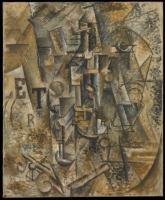
Picasso’s Unseen Portrait at the Metropolitan Museum
I was going to write about how the objects most frequently depicted by the Cubists in their café still-lifes – pipe, bottle, glass and guitar – were used not primarily as items characteristic of café-life as Rosalind Kr
16 Jan 2013 | 2 Comments
Sotheby’s Head Turner
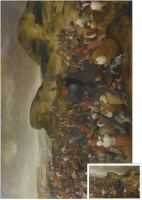
Two years ago, shortly after I began this website, Christie's sold one of the most important Old Master paintings to come on the market for years: Poussin's Ordination from the collection of the Duke of Rutland. The auction house helped by Pouss
23 Dec 2012
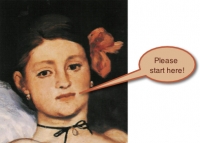
1, 2, 3. Please start here.
"The poets", a great literary critic once wrote, "do not read the same books as the academics or do not read them in the same way." She added, to explain how all great poetry is on the same path, that the gnosis of mind, or inner wisdom they sea
24 Nov 2012
Creativity in Science and the Arts
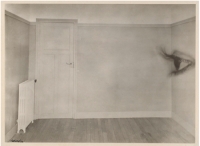
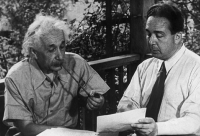
Today we tend to think that creative people find employment in the arts while those whose minds are capable of rigorous logic are more suited to science. It is, of course, entirely wrong as many may sense without knowing exactly why. The average
The EPPH Blog features issues and commentary.