Insight-Outsight
In art, as in language, there have always been two forms of vision, sight and insight. In the Middle Ages and the Renaissance "reality" was not considered to be in this world which is ever-changing and poorly perceived by our senses. Almost everyone in the Renaissance, regardless of their sect, thought that true reality was elsewhere where forms remained pure and constant. A popular tract, published by Martin Luther in 1516, argued that the right eye had the power to see into the eternal while the left eye saw the material world we know. The two together, though, cannot function as they ought to simultaneously. The left eye must shut off this world for the right eye to see eternity. This tradition has been widely used ever since and is still practiced today. It has, however, hardly ever been recognized, with James Hall a rare and notable exception.1 Among secular artists in tune with the Western tradition, an open eye signifies perception of this world, a closed one insight into the imagination.
All Articles (Alphabetical by Artist, then Title)
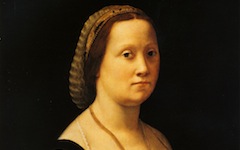

The pose in this portrait by Raphael, with the head turned upwards and away, has been described as a type suggesting that the Pope's secretary is listening to or witnessing divine revelation.
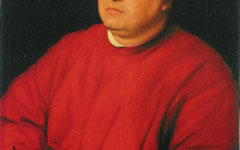
Raphael’s Tommaso Inghirami (c. 1511)
How the setting is so rarely what you think....you must think differently
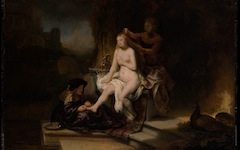
Rembrandt’s Bathsheba at Her Bath (1643)
Learn about other methods Rembrandt used to convey his message
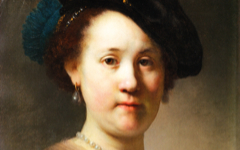
Rembrandt’s Portrait of a Young Woman (1632)
It can be difficult to explain why Rembrandt portrayed himself as a beggar. Here's what I think...
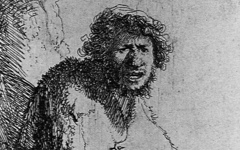
Rembrandt’s Self-portrait as A Beggar Seated on a Bank (1630)
If you didn't know that EPPH, you would never understand this image….nor would anyone else.
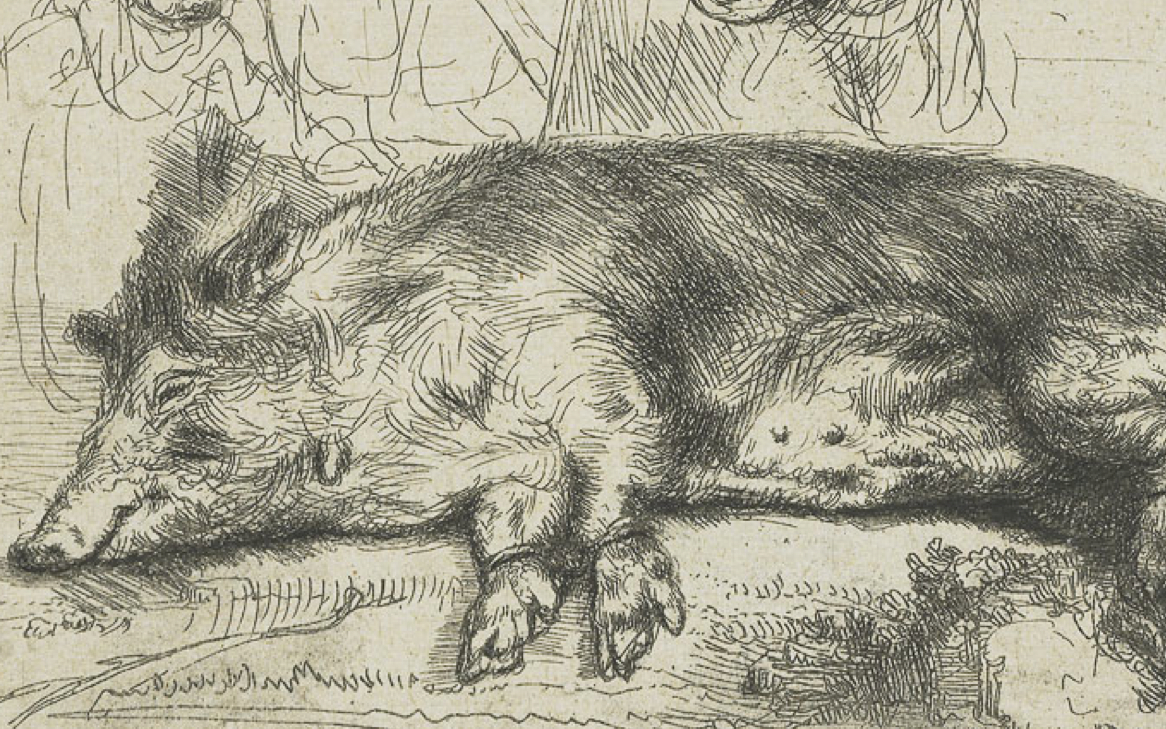
Rembrandt’s The Hog (1643)
The presence of a mystery in an artwork, intentionally made mysterious by the artist, does not mean that the mystery cannot be solved. Mysteries are made to be resolved.
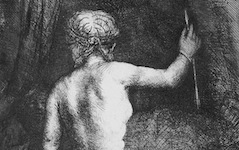
Rembrandt’s Woman with the Arrow (1661)
A quick insight into how artists' own sight combines insight with out-sight
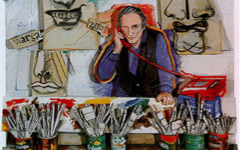
Rivers’ On the Phone (1955)
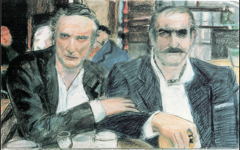
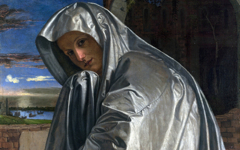
A much-loved painting contains a marvelous self-portrait in the clouds
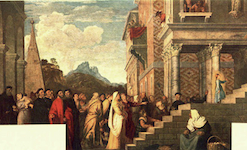
Titian’s Presentation of the Virgin in the Temple (1534-38)
Whatever the reasons for his style, Van Gogh made full use of the distortions
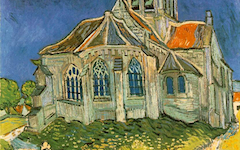
Van Gogh’s Church in Auvers-sur-Oise (1890)
This portrait of a one-eyed man is a simple illustration of the two modes of poetic vision: insight and observation.
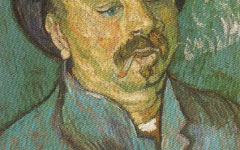
Van Gogh’s The One-Eyed Man
Artists often identify with other artists, using them as an alter ego. Here is an exceptionally clever one.
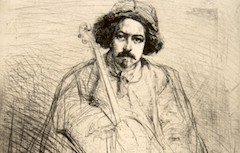
Whistler’s J. Becquet, Sculptor (1859)
© Simon Abrahams. Articles on this site are the copyright of Simon Abrahams. To use copyrighted material in print or other media for purposes beyond 'fair use', you must obtain permission from the copyright owner. Websites may link to this page without permission (please do) but may not reproduce the material on their own site without crediting Simon Abrahams and EPPH.