26 Apr 2012
Canvas is Canvas
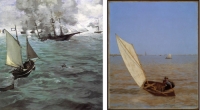
Most of the visual metaphors for an artist’s implements revealed here are related to their referent in art through their form, their function or some other more abstract link. A rifle or sword is long and thin like a paintbrush. They must be a
21 Apr 2012 | 2 Comments
Rembrandt and His Crucifixion (1631)
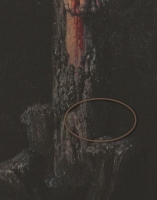
I can be very blind. Some time ago I added an analysis of Rembrandt’s Crucifixion in which I showed that Rembrandt had portrayed himself as Christ not out of delusions of grandeur but based on Christianity’s most fundamental principles
11 Apr 2012 | 2 Comments
Words on Words and Songs on Sound
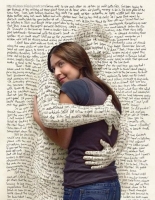
My beat is art history and I’ve spent15 years reading nothing but non-fiction loosely or closely related to art. My knowledge of contemporary literature is tenuous at best; my familiarity with music worse but I have a belief ba
31 Mar 2012
Shakespeare’s Triggers
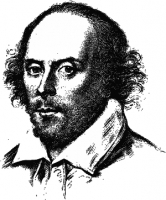
One of Shakespeare’s semantic tricks is to change the function of a word but still have it make sense. In the lines “To lip a wanton in a secure couch / And to suppose her chaste” the noun lip becomes a verb while wanton,
23 Mar 2012
Poems are Animals
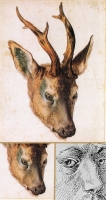
A recent exhibition posted an interesting quote by the poet Ted Hughes. It was somewhat out of their context but in ours because I, of course, argue that true art is like a visual poem. Remember as you read it that although many published poems
13 Mar 2012
Painting vs. Poetry
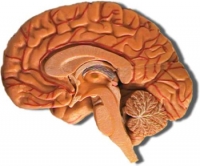
In the Renaissance there was a long-running debate over whether painting was as intellectual a medium as poetry. Poetry, whom no-one doubted was a “liberal” art, usually won the day as I believe it still would do in our contemporary
13 Mar 2012
Titian as Raphael
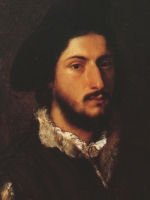
I've just added an entry on a little-known but very intriguing portrait by Titian, known simply as Titian's Portrait of a Gentleman. Painted around 1520, it is, I believe, Titian's tribute to the recently-deceased Raphael. Hanging in the Palazzo
09 Mar 2012
Turner Online
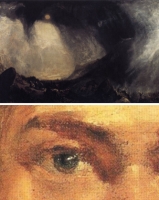
So many of Turner’s canvases are eye-shaped and his viewpoint so clearly Romantic and mystical that I cannot understand how so few people recognize that these images are taking place inside Turner’s mind behind his eyes. Simon Schama

06 Mar 2012
Quotation of the Week 6
Plotinus' advice on how to see God is equally, or you might think even more, true about art:
‘For one must come to the sight with a seeing power made akin and like to what is seen. No eye
04 Mar 2012
Advertising Art
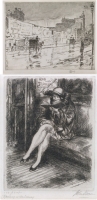
Two prints by different artists, both American admittedly but more than thirty years apart, were in the same auction this week (top and bottom)1 using the same “hint” – for want of a better term – that the actual su
03 Mar 2012
How and Why Artists Steal
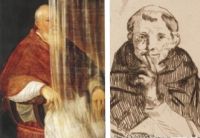
“It’s not always good to have ideas. Some people have a gift for coming up with ideas. But for those that don’t it is a real struggle. Oddly,” Paul Arden writes in his latest guide for creative wannabes, “the
01 Mar 2012
Oscars and Art 2012
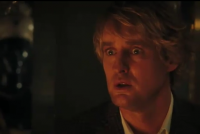
Did you notice how so many of the Oscar nominations for Best Picture were movies about movies, including the winner The Artist? For those living in caves this winter, The Artist is a mostly silent film about a silent star unable to make the tran
27 Feb 2012
Degas on Reflection and the Great Masters
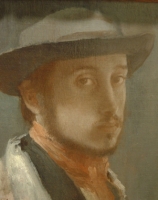
At the entry to a small, mildly interesting exhibition of Rembrandt’s engravings and their influence on Degas, the Metropolitan Museum has highlighted the following quote:
“What I do is the result of reflectio
23 Feb 2012
Faces in Our Minds
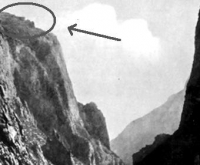
Humanity’s existence is so dependent on recognizing faces that our visual system specializes in it, reserving a large proportion of the brain’s neurons solely for that purpose. Amazingly we can even recognize a person in profile when we have
10 Feb 2012
Titian’s Danae..a “new” self-portrait
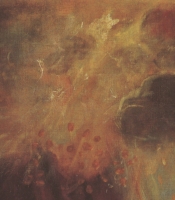
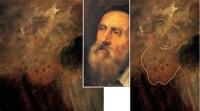
I've found a clearer image of Titian's own face, a previously unseen self-portrait, made from the clouds in his Prado Danae. You can see the tip of his nose in the center of this image, his far eye quite clearly indicated above it and sl
09 Feb 2012
The Artist as Creative God
The idea within esoteric Christianity that God is our innermost self, the universal self that we all share, has inspired many Western artists over the centuries to depict themselves as God in the process of creation. The ceiling of the Sistine C
05 Feb 2012
What is Art?
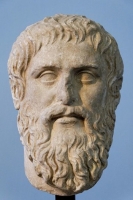
Edward de Bono, the polymath and creative thinker, has argued that argument as a way of thinking began with the Gang of Three: Socrates, Plato and Aristotle. Argument then became the default mode for human thought and while the method has served
04 Feb 2012
Physiognomy and Every Painter….
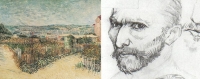
In the previous entry we saw how Degas’ beloved Little Dancer Aged Fourteen is partly modelled on the physiognomic ideas of Johann Caspar Lavater (1741-1801) and others. I mentioned this because Lavater also wrote: “Every painter paints
31 Jan 2012
Hollywood and the Man Within My Head
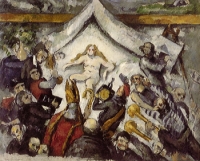
I’m always intrigued on perusing The Times Book Review by how many articles explain the object of their study in terms similar to those used here. It is no coincidence, of course. Every painter paints himself and all it entails is probably
29 Jan 2012
Leonardo on Creating Art as the Subject of Art
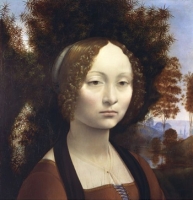
I often argue that the subject of a painting is its own making and have already demonstrated this online in several hundred entries, including examples by Leonardo.1 Evidence in written commentary by artists, though, is much rarer. Nevertheless
30 Dec 2011
Carpaccio’s Dragon’s Blood
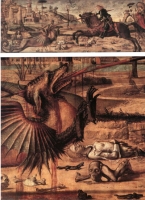
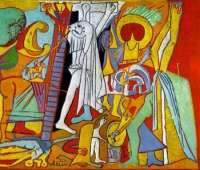
Carpaccio’s remarkable series of wall decorations on the saga of St. George in a small Venetian scuola captured my attention twelve years ago, at the start of my own quixotic quest to convince the art world that the subject of true art is
16 Dec 2011
Importance of Interpretation
People use this site to help develop their ability to interpret works of art and thereby increase their aesthetic satisfaction. To look at art without trying to interpret it leaves you looking at a pretty picture, little more. Certainly the brus
10 Dec 2011
Portraits: Icons of America
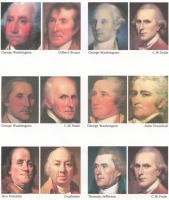
Portraits make popular art exhibitions because we all think we can “read” a face. It’s part of being human. Everyone is his or her own expert on other people’s faces. Besides, portraits help satisfy our natural inquisitiv
02 Dec 2011
The Renaissance Portrait from Donatello to Bellini #3
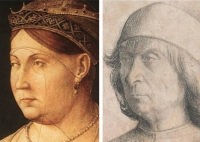
Both portraits above will be in the exhibition at the Metropolitan Museum (Cat. #163 and #159) and may even be hung near to each other where the similarity will surely be noticed. The portrait of Caterina Cornaro, Queen of Cyprus (left), i
30 Nov 2011
The Renaissance Portrait from Donatello to Bellini
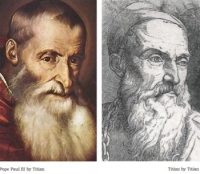
On December 21st the Metropolitan Museum, New York, will be opening an exhibition titled The Renaissance Portrait from Donatello to Bellini. As long-time users know, the whole idea behind this site and its blog is that art, especially Renaissanc

10 Nov 2011
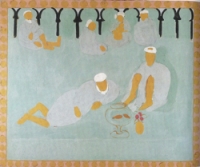
The Importance of an Artist’s Turban
I've been looking forward to discussing turbans for some time because, for an art lover, a little knowledge can go a long way. Almost everyone thinks of them as oriental in some manner but, up until the end of the eighteenth century, you could f
04 Nov 2011
Quotation of the Week #5
‘…the symbolical creations of geniuses are unfortunately harder to nail down to a definite subject than the allegorical inventions of minor artists.’
Erwin Panofsky, art historian (1892-1968)1
30 Oct 2011 | 2 Comments
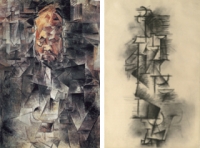
Cubism Explained
No-one, to my mind, has ever satisfactorily explained Cubism. Indeed I have found the explanations and their complexity totally confusing. Roland Penrose, a close friend of Picasso, claimed that Cubist images try:
‘to state t
10 Oct 2011
Quotation of the Week #4
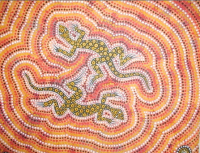
"Meaning is for those who are ready for it, for those who are trained for it. The rest get pretty pictures."
Les Bursill, an aborigine on aboriginal art
04 Oct 2011
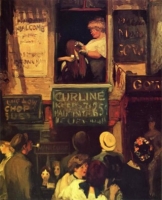
John Sloan and his Ashcan Paintings
I mentioned a month ago that I would be reviewing Michael Lobel’s article in the Art Bulletin on John Sloan, the Ashcan artist of early twentieth-century New York.1 In it he looks at half a dozen works by Sloan between 1907 and 1910 to dem
The EPPH Blog features issues and commentary.