31 Aug 2011
The Importance of Source-Hunting
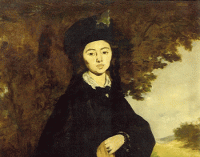
Source-hunting, searching for the origin of a form in an earlier artist’s work, is one of the most maligned activities in art scholarship. John Shearman, a professor of the history of art at Harvard, wrote:
‘The study of sou
23 Aug 2011
Dreaming in Art vs. Illustration
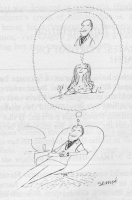
“How do you know that this is a picture of him dreaming of her dreaming of him?” That is the question four art historians ask in a 1989 book titled Puzzles about Art. They don’t try to resolve their question about The New Yorke
02 Aug 2011
Dürer’s Portrait of Philip Melanchthon (1526)
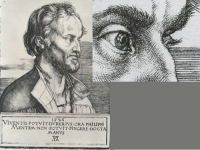
Durer’s 1526 Portrait of Philip Melanchthon is notable for the manner in which the artist treats the eyes. One eye is large, bright and clear; the other mostly unseen, the tip of its eyelash just visible above the clouds. This contras
12 Jul 2011
Introducing Bellini’s “Eyes”
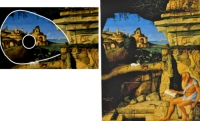
I have recently introduced the argument that a significant number of compositions by Giovanni Bellini are not just representations of the apparent scene but, on another level, are representations of giant “heads”, “faces” or parts of fac
04 Jul 2011
Left Right, Open Closed: Eyes and Perception
I have explained under the theme Insight-Outsight how poetic painters often distinguish between two different modes of perception: outwards to see the exterior world of matter, inwards for insight into the soul and imagination. It is such a comm
20 Jun 2011
EPPH’s Principal Principle 1: What is Art?
I’ve received criticism from a frequent viewer that this site is too devoted to portraiture. Certainly the discovery about portraits is the simplest new idea to grasp and, for that reason, is featured on the video. It is only, though, one smal
30 May 2011
Metamorphic Form
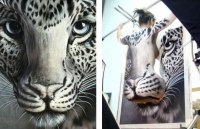
Craig Tracy, a painter and former illustrator, creates arresting images (left) and then shows us how he did it (right). Few art historians realize that great masters, far more creative obviously than Tracy (no offense intended), often use the sa

07 May 2011
Ballasteros and Art’s Bubble
Artists when they conceive their images, even before they begin to paint, are in their studio. The word studio comes from the little room in which Renaissance princes went to study and think. At a time when most people’s lives were played
06 May 2011
Picasso’s Ps
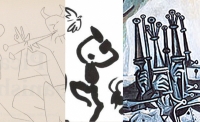
Remember to look for signatures on paintings because their careful placement can add meaning. It is rarely seen by those who are not artists themselves. Sometimes the artist's initial or initials are disguised as objects in nature so the vie
01 May 2011
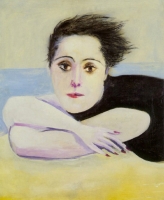
Picasso’s Pain on Being an Artist
If Picasso saw an attractive subject, like a girl lying on a beach, he would cryptically say :
“What a pity one isn’t a painter! If one was a painter one could do her portrait!”
What did he mean? Picasso&
25 Apr 2011
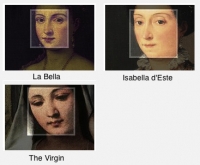
Face Recognition
Organizing family photos is not my thing; can never get around it; and rarely look at them either. That is by way of explaining why my first brush with face recognition software was the above request from IPhoto to explain my relationship
22 Apr 2011
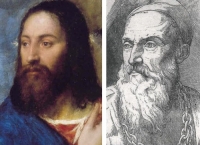
Titian as God
There's a whole new theme at Every Painter Paints Himself and one I've been looking forward to because more than any other theme on the site it demonstrates how artists followed the various traditions of mystical Christianity and not the
20 Apr 2011
Celebrating Good Friday
Isn’t it rather morbid and paradoxical for Christians to celebrate the death of Christ on Good Friday? What’s so good about killing your God? Ah, you’ll be told, that was the day He died for our sins for all humanity? But doesn
16 Apr 2011
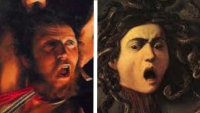
News of Caravaggio’s Execution
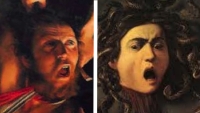
I don’t think anyone has ever noticed that Holofernes’ head in Caravaggio’s Judith and Holofernes is the mirror-image, modeled by someone else, of his own Self-portrait as Medusa from two years earlier. The idea, then, that Hol
15 Apr 2011
Bizarre but True!
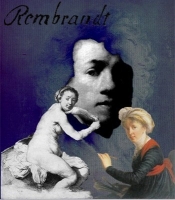
I’ve just placed a short essay on the site titled “How Forms in Art Work.” It describes as far as we can tell how images appear in an artist’s mind and in their art. I wrote it a few years ago to correct a mistaken view a
14 Apr 2011
Is the Mona Lisa Leonardo’s male lover?
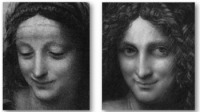
“Groundless” grumped Pietro Marani, a Leonardo authority, about a new theory offered from outside his field. He was responding as academics do to the report of an Italian researcher, Silvano Vinceti, on how several of Leonardo’s works, inc
08 Apr 2011
Art vs. Illustration
Art is not illustration. We all know that. Illustration simply depicts a verbal story and that alone cannot be art. We call those image-makers “illustrators” because they copy reality or a written story. We should not give them the grander t

28 Mar 2011
The “Open Drawer” Question
I’m traveling and don’t have much time to go into explanation. For more than ten years I have been bugged by the “open drawer” question: why do so many still-lifes by artists as different as Picasso (above) and Chardin ha

14 Mar 2011
Bacon and Daumier
A recent entry on one of Daumier’s Don Quixote and Sancho Panza paintings showed that the knight’s lance and shield are really substitutes for the artist’s brush and palette. Even the other way round, when Daumier depicted an ar

02 Mar 2011
Charlie Sheen Paints Himself
The rant by actor Charlie Sheen now sounds angelic next to the fashion designer John Galliano’s disgusting remarks. You may not know what either said, just that both got into trouble with anti-semitic outbursts the same week. Watching the

21 Feb 2011
As Time Goes By
Irina Werning, an Argentine photographer, takes pictures of friends re-enacting photos from their youth and then depicts them side-by-side. I find them fascinating, in part because we all age in slow-motion, in part because the resemblances betw

30 Jan 2011
Note on Style
Style, the traditional method of classifying art, is rarely mentioned on this site because it has little effect on interpretation. Mark Roskill, the late art historian, wrote in his book The Interpretation of Pictures:
‘Discussion[s]

21 Jan 2011
What Graphic Designers Know
Artists put meaning in their work by using methods that most viewers never see. Indeed that's what this website's about. Graphic illustrators put meaning in their work too. What few know though, perhaps even themselves, is that they

17 Jan 2011
Manet’s Errors
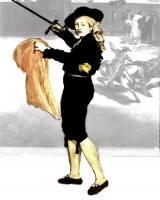
Edouard Manet would have been amused by his critics, then and now. In the 1950’s Clement Greenberg placed Manet at the center of his theory that modern painting had no meaning beyond emphasizing its own essential character. Thus the “flatnes

13 Jan 2011
How Swords Become Paintbrushes
Even though artists across the ages have morphed swords into paintbrushes and spears into etching needles, few have ever been recognized. Indeed the use of weapons as visual metaphors for the tools of an artist is so widespread in art generally

08 Jan 2011
Picasso and Paul McCartney’s Two Fingers
Alberti’s Window, an art history blog, has an intriguing video of Paul McCartney discussing the origin of his song Two Fingers. McCartney was in the waiting-room of a hospital staring at a poster of Picasso’s painting, The

03 Jan 2011 | 1 Comments
Why painters paint themselves
I spend so much time demonstrating that conventional perception of art is mistaken that I seldom explain why every painter paints himself is such a profound idea. It is, in essence, the basis of consciousness. Every time we recount a childhood s

18 Dec 2010
A Visit to the French Ambassador
I’ve just been to see Palazzo Farnese, the great French Embassy in Rome, partly designed by Michelangelo, which is rarely open to the public. They’ve arranged a wonderful exhibition with loans from Naples and Parma to celebrate the F

19 Nov 2010
Bronzino’s Ginger Hair
No-one knows how Agnolo di Cosimo gained his nickname, Bronzino, but the general view seems to be, without any evidence, that he may have had a dark complexion. Yet how about the color of his hair? A portrait of Bronzino by an unknown painter sh

10 Nov 2010
Gauguin’s Method
I was reading about Gauguin today and his own explanation of The Vision after the Sermon: Jacob Wrestling with the Angel. It struck me that if I was trying to explain this image I would say the same: that the figures in the foreground represent
The EPPH Blog features issues and commentary.