25 Jun 2014 | 2 Comments
Is self-representation self-centered?
(On vacation. A re-post from last summer)
The practical and philosophical issue of whether figures in art depict the artist or the apparent character is well expressed by two different translations of the same text in a Upanishad. The p

26 May 2014 | 1 Comments
Magic from Matisse and Michelangelo
What does Matisse’s figure from Dance II (1910) have to do with Michelangelo’s St Peter from the Last Judgment (1534-41). More than you might think. Bear with me. Both are nude against a blue sky, facing us and facing left; both look a littl
13 May 2014
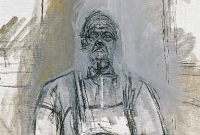
Giacometti on his Sitters’ Inner Being
So much of the poetic method in art remains a closely-held secret. Like initiates in a mystery religion, great artists have long had a common understanding that what they prize in their creative process should not be shared with the unappreciati
09 May 2014
Naming Names
Names limit. We need them as shorthand, to avoid explaining everything from scratch. But they deceive, confuse and blind. I'm talking about names in everday life and how, once used, they pigeon-hole the person, the object, the idea or whatever i
08 May 2014
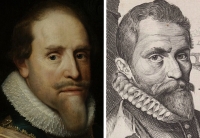
Dutch Royals Are Artists
I received a message from the Rijksmuseum that their superlative site, the Rijkstudio, now has a collection of Dutch royal portraits. Anyone who has seen on EPPH how portraits of British, Italian and French royalty resemble the artist might wonder
01 May 2014 | 1 Comments
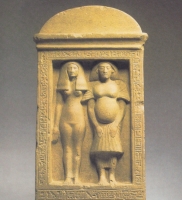
An Intriguing Self-portrait, c.1345 BC
One of the earliest surviving self-portraits from antiquity is that of Bak, chief sculptor to the Egyptian pharaoh Akhenaten. It is beautifully preserved in Berlin (above) and is very intriguing given Western art history’s traditional descript
23 Apr 2014
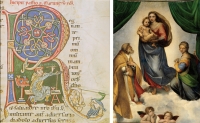
Raphael, a Brother, and an Initial Idea
Art, according to EPPH, is esoteric, a visual primer on the Inner Tradition created by women and men every bit as spiritual as a robed monk, often more so. Indeed in the Middle Ages most artists were clerics or monks working in the scriptorium o
17 Apr 2014
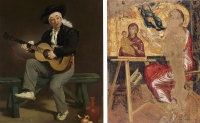
Manet’s Spanish Singer Raises a Leg
Inspiration can come from anywhere so it's a good idea to look at the art of all periods. Artists do so, no matter which century they live in. A few days ago I solved one of my long-standing problems with a picture by the19th-century artist Edou
14 Apr 2014
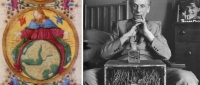
Joseph Cornell gives birth to a box…
Birthing, physical birth, is one of poetry and art’s most powerful metaphors used for many centuries, perhaps ever since art first appeared. It plays on the relationship between sexual conception and mental conception while often conveying that

13 Apr 2014
The Artist is Always Present
Very few novels use the first person pronoun, most using an impersonal narrator to describe the scene. The author David Henry Thoreau noted that, with the ‘I’ omitted, the reader forgets that it really remains there because the novelist is c
25 Mar 2014 | 1 Comments
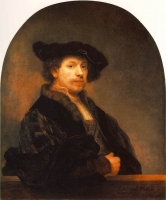
Lights on Rembrandt
What does Rembrandt mean? Not his art but his name. No-one's asked that before. In a beautifully written essay Zhenya Gershman, a successful artist and EPPH follower, reveals how its meaning is reflected in all his art and even his very being. She

13 Mar 2014
Flat Noses on a Frontal Face
A year ago I used this early portrait drawing by Ingres (left) to demonstrate that Picasso's combination of faces from differing viewpoints, a hallmark of Cubism, was a technique practiced by earlier artists for a similar reason. Ingres, for ins
10 Mar 2014
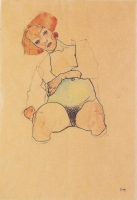
Egon Schiele’s Green Belly
There is no such thing as art for art’s sake. It is a contradiction in terms. The early 19th-century art historians could see little beyond narrative so when art started to lose its connection to an apparent subject, they assumed such works we
03 Mar 2014
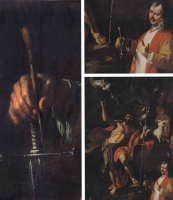
The Brush-Sword of Mattia Preti
After the recent post on a new book of cartoons, Daggers Drawn, this one is on the same subject 350 years earlier.
Mattia Preti (1613-1699) was a major Italian artist who is little-known because he spent much of his life on the islan
25 Feb 2014
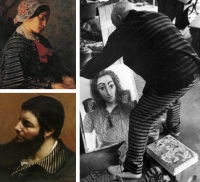
Picasso-as-Courbet
Many great artists I follow use a feature other than the face to identify themselves in pictures that are not self-portraits. Given that all their figures represent the artist, they need a variety of methods to hide and reveal their self-referen
23 Feb 2014
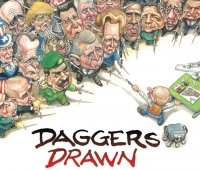
Daggers Drawn
Daggers Drawn. A new compendium of a political cartoonist’s 35 years in the business and on the cover he stands at his desk, pen drawn, facing the dictators and democrats he has followed, all with daggers drawn too. The conclusion is simple to
18 Feb 2014
Art’s Purpose
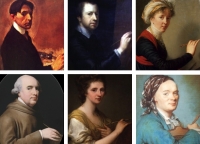
To become like God (ie, gain access to Wisdom) has long been the principal goal of all who practice inner-focused spirituality. The group includes not only monks and nuns in cloistered communities but spiritual seekers in the wider world as well
16 Feb 2014
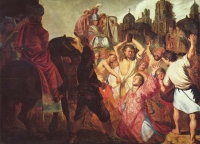
Is Stoning Stephen Grinding Colors?
In the wider world of art history where the word "art" has not been properly defined, the search for meaning is more complex and difficult than it is here. If biologists studied different types of trees without agreeing on what a tree was, they to
12 Feb 2014
Note on Palette Sounds
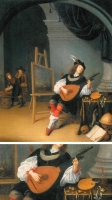
My recent post on artists using stringed instruments as metaphoric palettes was restricted to guitars so I did not use this image. Perhaps I should have because while musicians may think lutes and guitars are very different, in artworks they are
10 Feb 2014
The Poet’s Eye
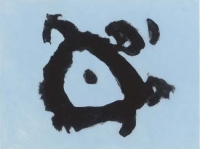
What you see may not be all you see because somewhere inside most true artworks one form is laid over another. Here's a simple example from a print made by Robert Motherwell (1915-1991), a leader of the New York School in the mid-twentieth century
09 Feb 2014
Artists and the Thumb-hole of a Guitar
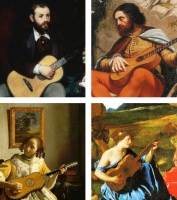
I read once that Cézanne prepared his palette with as many as 18 pigments and lined them up in a series like musical scales.1 It’s an apt analogy because painters have long portrayed musicians as an allegory of their own poetic performance in
04 Feb 2014
A Musical Note and Letters
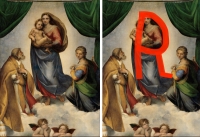
It's a red-letter day for Raphael. I have been showing a lot of letters recently, how Raphael and Renoir each used objects shaped like an R, how Manet and Matisse used M’s and Ingres used an I. And I doubt before this evening that anyone has e

26 Jan 2014 | 1 Comments
Trees as Paintbrushes
Looking out my study window in Italy something struck me that you might only notice in life not paint. Not far from the house, lower down, is a row of cypresses. When the wind blows, the pointed tops move back and forth over the distant landscap
22 Jan 2014 | 2 Comments
What’s Wrong with the Art World?
What is wrong with the art world? Why can't they see Van Gogh's self-portrait in the fireplace (above)? It is so obvious that a child would recognize it if shown. Whatever the reason, no expert can. That means that this colorful and late self-po
13 Jan 2014
Good Art is Not Original
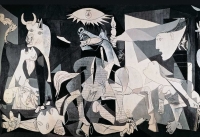
There are some no-nos on EPPH to make conventional minds scream. No biography. Who cares how many women Picasso lived with? It makes no difference to the meaning of Guernica or even to images nominally depicting his loves. No historical or liter

09 Jan 2014 | 7 Comments
Keith Haring’s Secret Knowledge
EPPH has already shown how at least 7 major artists depicted themselves as lions (see below). There are more to come but many are by Old Masters and are quite subtle. Here’s an obvious example, an actual self-portrait, by an artist who was all
05 Jan 2014 | 2 Comments
How God became Woman
Art is so pregnant that it can take months for its hidden meaning to emerge in your thought. That’s why we try to enter the artist's mind, not just through social customs and the religious dogma of a period but also through art's own culture w
15 Dec 2013
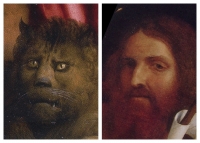
Lotto’s Lion and The Mystical Marriage of St. Catherine
After the recent post about how Sir Edwin Landseer became a couple of dogs (seriously), I thought it would be a good idea to keep up the pace and show how Lorenzo Lotto became a lion. Near the lower edge of one of his greatest masterpieces, The
15 Dec 2013
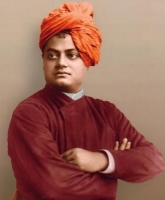
Your Self is My Self
You can find wisdom within all major religions (and an awful lot of nonsense too). Some of the Eastern traditions which openly concentrate on training the mind and looking inwards are particularly useful for understanding art in all media. Thatâ
14 Dec 2013
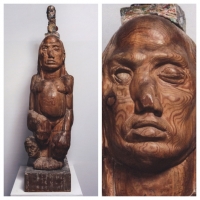
Winking in Art
Russian artists in the early 20th century turned to the West to absorb the latest trends happening in Paris. That’s the conventional story. Yet, little known, at the same time they were also turning eastwards towards Siberia and Russia’s ori
The EPPH Blog features issues and commentary.