21 May 2013
Plays on the Mind
The Wall Street Journal recently reported that Richard Foreman, an experimental playwright for more than four decades "has presided over heady spectacles that mingle the conventions of theater with ... stroboscopic stage sets designed as embodim
11 May 2013
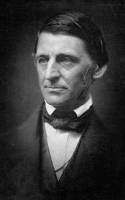
Emerson on Mind
When I started out I soon realized that every true work of art fulfilled the Renaissance saying that titles this site. EPPH, in short. Now, in more recent years, I have come to recognize that every artwork, like every church and temple from the
20 Apr 2013
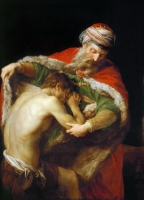
Do you know what it means to come home?
Think differently. The old ways are often dull and didactic. Take, for instance, paintings and prints that seem to illustrate Bible stories. Why treat them as a narrative when mystical Christians, among whom must be counted many great Western ar
15 Apr 2013 | 1 Comments
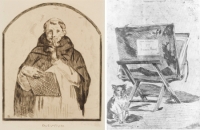
Understanding how you are God
If you want a short and concise explanation of how today's mystical Christians think about God, read Carl McColman's excellent post on Does God = Consciousness? He responds to the letter of a theoretical physicist trying to reconcile his
12 Apr 2013 | 7 Comments
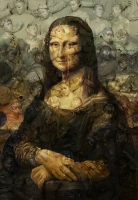
How a Scientist Solved the Puzzle of the Mona Lisa
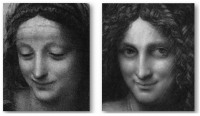
The true identity of Leonardo's Mona Lisa has been a long-running mystery captivating generations of art lovers and scholars. Yet the most crucial piece of information about the Mona Lisa missing from standard textbooks is that the proportions o
10 Apr 2013 | 1 Comments
Leonardo’s Facial Mystery
The discovery that great portraits do not depict identifiable people, as long believed, is a real eye-opener. (See the book free online titled Every Painter Paints Himself.) Yet the significance of what you can now see in portraiture can only be
03 Apr 2013 | 3 Comments
Art as a Spiritual Guidebook
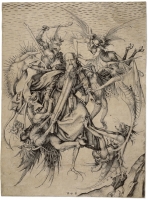
Some readers may wonder - not many, I hope - how and why I describe so many different figures in art, from the Middle Ages to Picasso, as yet another representation of the artist. It can seem repetitive and boring, even simplistic. Yet it is a b
26 Mar 2013
When Degas made a boob ...on purpose
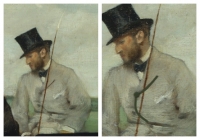
In a new entry published today you can see for the first time ever how Edgar Degas turned his friend, Edouard Manet (above), into the driver of a carriage holding his whip as a paintbrush flecked with white paint. He then transformed the artist&
23 Mar 2013
Drawings as Ideas in the Mind
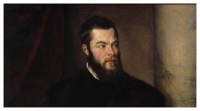
Concepto, concetto, esemplo, modello. Michael Cole and Mary Pardo, writing about the studio in the Italian Renaissance, have pointed out that the terms artists then used for a working drawing, what we today might call a sketch or study, were the
20 Mar 2013 | 2 Comments
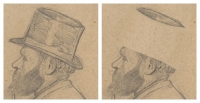
How Degas drew a top hat…
Art is so pregnant that even in a "simple" sketch like Degas' Edouard Manet at the Races (c. 1865) there is always something more. I thought I had drained the drawing when I finished writing about it yesterday (see entry). And, then, this m

16 Mar 2013
Is this Roy Lichtenstein’s new coat of paint?
Puns, word-play, double-entendre, homonoyms....painters pun like poets and almost as frequently. The chances that Roy Lichtenstein did not think of a "coat of paint" while drawing this image are so small that we should assume he did. Turn to the
09 Mar 2013
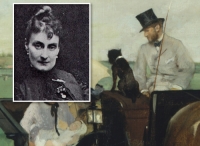
Proust’s and Degas’ Disappearing Models
Literature and its methods are a useful yardstick by which to judge our knowledge and understanding of the visual arts. For instance, the known fact accepted by literary critics that many friends and acquaintances of Marcel Proust, the great Fre
08 Mar 2013
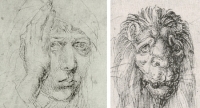
Dürer’s Foreign Language
"The art of painting cannot be truly judged save by such that are themselves good painters: from others, verily is it hidden, even as a strange tongue."
Albrecht Dürer (1471-1528)1
If, as I believe, Dürer disguised
03 Mar 2013
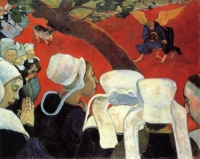
Gauguin Wrestles with Art
Gauguin's great painting of Jacob wrestling with the Angel is commonly known as Vision after the Sermon, perhaps to make sense of the women who were obviously not present in the Bible story. Two years ago I explained the scene as taking plac
18 Feb 2013
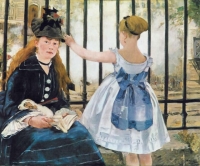
1+1=1: The Divided Self in Manet’s Railway
What is the girl up to? Who are they? What's happening? Why do they wear the same color clothes? Why is the girl's hair so odd?
In my explanation two years ago of Edouard Manet’s The Railway (1873) I noted that the extended arm of the

13 Feb 2013
Logos (no, not that one!) and Art
Foreign words can sometimes sound more intellectual than those we use in English. That's why when logos is mentioned in reference to art it generally refers to the beginning of St. John's Gospel and is set in italic…"In the beginning

02 Feb 2013 | 15 Comments
Roy Lichtenstein’s Plagiarism
Plagiarize! Plagiarize! Let no-one else's work evade your eyes! Remember why the good Lord made your eyes, So don't shade your eyes, But plagiarize, plagiarize, plagiarize.....
Tom Lehrer's comical lyrics from the 1950's were pierced

29 Jan 2013 | 5 Comments
2nd Self-Portrait Found in Same Met Gallery!
After discovering a self-portrait by Picasso four days ago (see blog), I think I've discovered another one, this time by Bonnard.....hanging right opposite the other one at the Metropolitan Museum! The "coincidence" demonstrates, if nothing else
25 Jan 2013 | 3 Comments
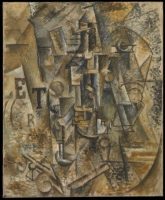
Picasso’s Unseen Portrait at the Metropolitan Museum
I was going to write about how the objects most frequently depicted by the Cubists in their café still-lifes – pipe, bottle, glass and guitar – were used not primarily as items characteristic of café-life as Rosalind Kr
16 Jan 2013 | 2 Comments
Sotheby’s Head Turner
Two years ago, shortly after I began this website, Christie's sold one of the most important Old Master paintings to come on the market for years: Poussin's Ordination from the collection of the Duke of Rutland. The auction house helped by Pouss
23 Dec 2012
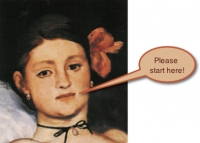
1, 2, 3. Please start here.
"The poets", a great literary critic once wrote, "do not read the same books as the academics or do not read them in the same way." She added, to explain how all great poetry is on the same path, that the gnosis of mind, or inner wisdom they sea
20 Dec 2012
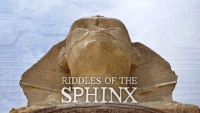
Whose face is the Sphinx?
I've been trying to read while a Nova documentary, The Riddle of the Sphinx, played in the background. The narrator described how an Egyptian stone carver called Fahi had been commissioned to sculpt a small-scale version using local stone. "
11 Dec 2012
Memory Holloway and Picasso
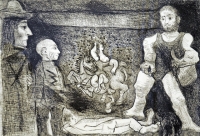
Memory Holloway, an art historian at the University of Dartmouth, Massachusetts, has written a wonderful book on a magnificent group of etchings by Pablo Picasso. It is titled Making Time: Picasso's Suite 347. Suite 347 is the name given to
01 Dec 2012
Pointing at the Edge
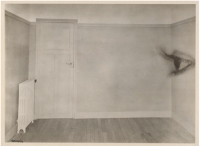
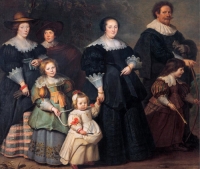
If you cruise the various interpretations on this site, you might have noticed a tendency to explain a figure with an arm or hand pointing to or touching the edge of the image as the artist himself painting a self-portrait. Michael Fried first n
24 Nov 2012
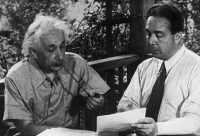
Creativity in Science and the Arts
Today we tend to think that creative people find employment in the arts while those whose minds are capable of rigorous logic are more suited to science. It is, of course, entirely wrong as many may sense without knowing exactly why. The average
20 Nov 2012 | 1 Comments
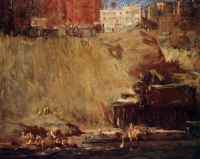
Bellows’ River Rats At the Metropolitan Museum.
George Bellows’ exhibition at the Metropolitan Museum opened last week and is well-deserved, showing us for the first time in modern memory the full scale of what he achieved in twenty-something years. He died at 42. The success of h
19 Nov 2012
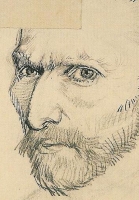
Seeing Through the Artist’s Eyes
Michelangelo's Art Through Michelangelo's Eyes (2005) was my first publication because it demonstrates how important it is to look at poetic art that way, through the eyes of the artist. I have continued to show how the same method works wi
17 Nov 2012
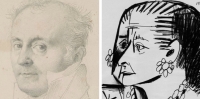
Mental images from Holbein, Ingres and Picasso
It is well-known that Picasso admired Ingres' portrait drawings like the one above on the left. Separately I have shown how Ingres, like other great masters, changed the facial features of his sitters to fuse them with his own. Not all portraits
13 Nov 2012
Six Tips on How to Look at Art
The idea, peddled by many, that you can just stand in front of a work of art and let it speak to you is wrong. What, for instance, happens inside you when you look at the Mona Lisa? Probably not much. Indeed, as an adolescent trying to figure ou
The EPPH Blog features issues and commentary.