Brush and Palette
One of the longest-running, little-known traditions in Western art is the use of visual metaphors for the tools of the artist’s trade, most commonly brush and palette. Daggers and swords, which are long and thin like a paintbrush, are often used to symbolize brushes while the accompanying battle or fight depicts, unseen by the unsuspecting viewer, the artist’s own creative struggle. Palettes are suggested in circular objects such as shields, plates, or flat surfaces such as tables. A bunch of flowers, often circular, can also suggest the many different colors on a palette. And, although Michael Fried has noted similar symbolism in Courbet’s paintings and recently in Caravaggio's too, visual metaphors for the tools of an artist's craft have been used in paintings since at least the early Renaissance.1 Here, for the first time, we show how common they are in art of the past six centuries and how crucial to the meaning of the work too.
1. Michael Fried, Courbet’s Realism (University of Chicago Press) 1990; Fried, The Moment of Caravaggio, A.W. Mellon Lectures in the Fine Arts (Princeton University Press) 2010
All Articles (Alphabetical by Artist, then Title)
Learn how Picasso used swords as "paintbrushes", "etching needles" and other tools of the trade

Picasso’s Swords and Knives
Learn how Picasso used another artist's name to represent his own identification with the great masters of the past
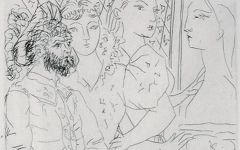
Picasso’s Three Actors (1933)
Hear how Karen Kleinfelder interprets Picasso's scene
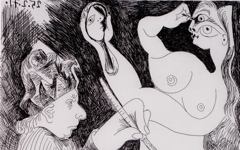
Picasso’s Untitled Plate 58 from Suite 156 (1971)
Don't accept your first understanding of a line. Think again; because artists do before drawing it.
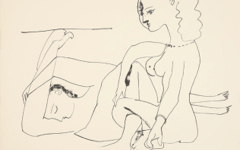
Picasso’s Women on the Beach (1947)
A resurrection by its very name suggests two realities: the old and the new, the illusory and the real.
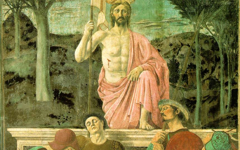
Piero della Francesca’s Resurrection (c.1458)
We have seen elsewhere how artists use the arrows of St. Sebastian, the saint's identifying attribute, as symbols for their own paintbrushes.
Raphael’s Galatea (1512)
How even the young Raphael depicted the divinity of the artist's mind
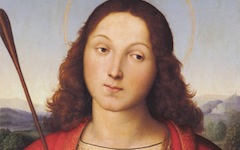
Raphael’s Saint Sebastian (c.1502-3)
Sometimes the most difficult features to see in art are the most obvious
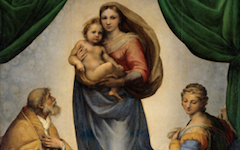
Raphael’s Sistine Madonna, Part 1 (1512)
How the setting is so rarely what you think....you must think differently
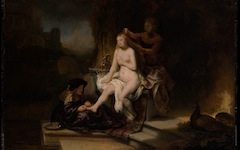
Rembrandt’s Bathsheba at Her Bath (1643)
See how Rembrandt concisely expresses the underlying idea of art in a Roman myth
Rembrandt’s Lucretia (1666)
Several clues, easy to spot, reveal the true underlying meaning of two similar masterpieces
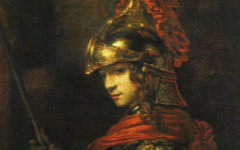
Rembrandt’s Man in Armour (1655) and Minerva (c.1655)
If you didn't know that EPPH, you would never understand this image….nor would anyone else.
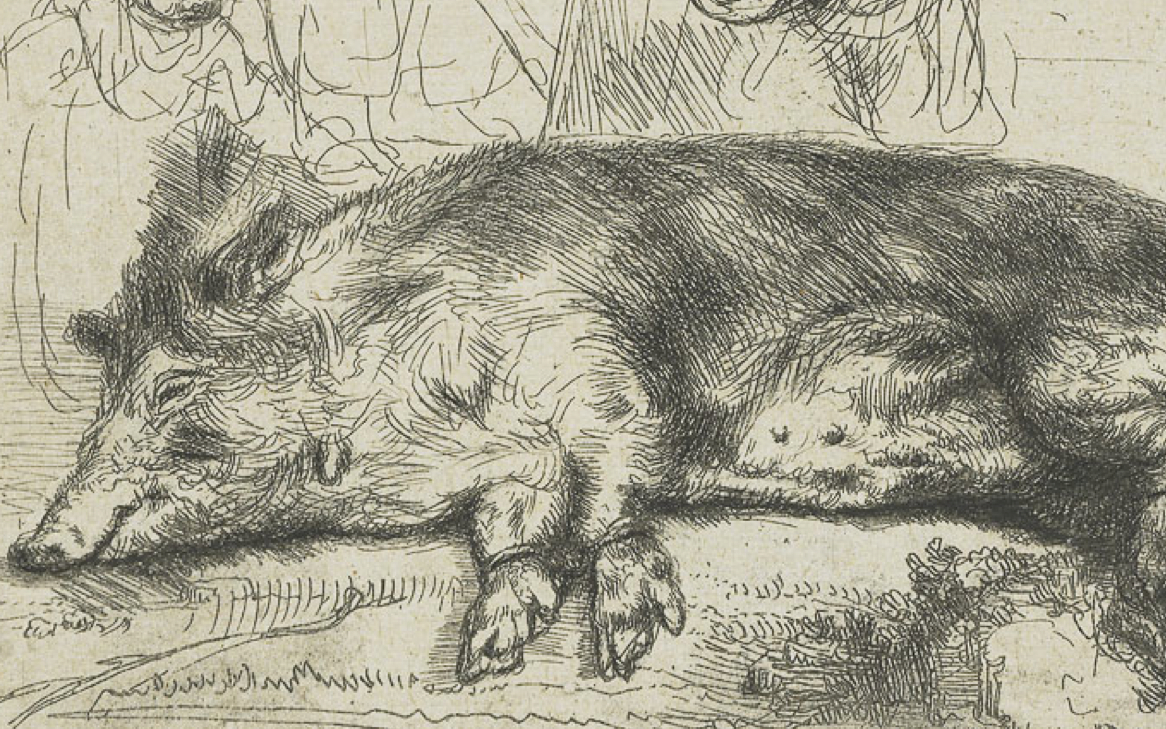
Rembrandt’s The Hog (1643)
How Rembrandt's method, and that of great artists in general, is present in his earliest extant painting
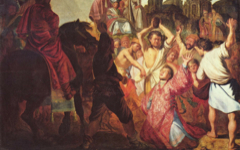
Rembrandt’s The Stoning of St. Stephen (1625)
The presence of a mystery in an artwork, intentionally made mysterious by the artist, does not mean that the mystery cannot be solved. Mysteries are made to be resolved.
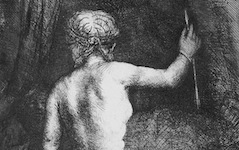
Rembrandt’s Woman with the Arrow (1661)
Discover a common way how artists demonstrate their identity with their protagonist. You can use the method to interpret other paintings by other artists.
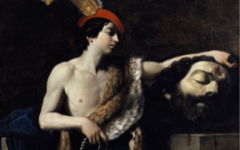
Reni’s David with the Head of Goliath (1605)
Once you see how Norman Rockwell, the so-called illustrator, turned contemporary politics into a contemplation on the creative process, you should start to appreciate how ageless the theme is.
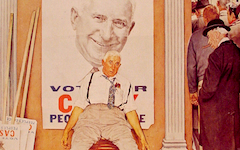
Rockwell’s Before and After (1958)
The Inner Tradition as practised by a Catholic artist....
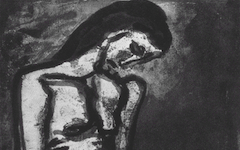
Rouault’s Miserere: Eternally Scourged (1922)
See how Rubens turned a variation on a Leonardo composition into a scene of creative struggle in his own mind
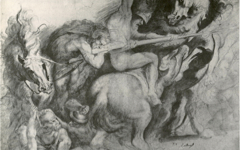
Rubens’ Battle of the Standard (c.1600) after Leonardo
Learn how one artist copies another and makes it his own
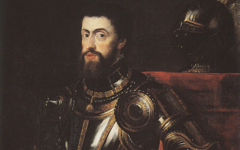
Rubens’ Copy of Titian’s Charles V in Armor with a Drawn Sword (c.1603)
In a poster for an exhibition of his paintings (above) Egon Schiele drew on the age-old tradition of presenting St. Sebastian as a symbol for the artist himself suffering the pangs of artistic creation.
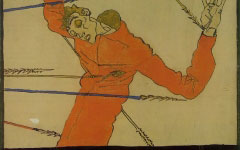
Schiele’s Self-portrait as Saint Sebastian (1914-15)
How even in the 15th century an artist thought of himself as Christ...and said so.
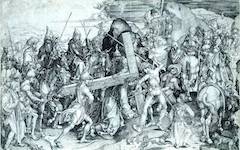
Schongauer’s Christ Carrying the Cross (c.1475)
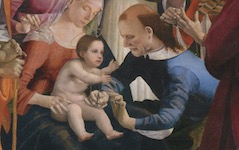
Evidence for art's self-referential allegory pre-dates the High Renaissance
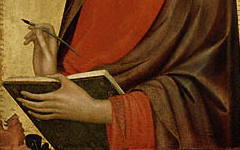
Simone Martini’s St. Luke (c.1330’s) and other saints
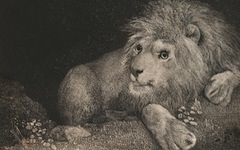
Have you ever wondered why so many still-lifes have an open drawer under the table-top?
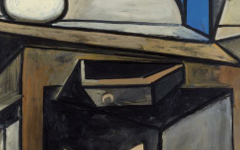
The Open-Drawer Question
Yet another visual illusion that has never been published.
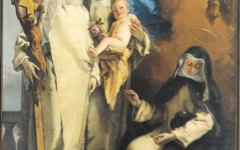
Tiepolo’s Virgin Appearing to St. Catherine… (1748)
It is impossible to exaggerate the importance of how Renaissance artists identified with God. Both pervasive and unknown, the idea needs emphasizing to demonstrate its near-ubiquity. Here is yet one more example by Titian.
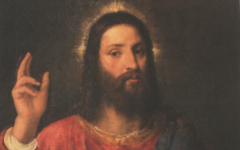
Titian’s Christ Blessing (c.1560)
Baudelaire's linking of Painting with cosmetics in the nineteenth century was not a novel idea, as long believed, but one with a very long history indeed
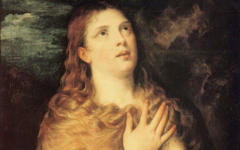
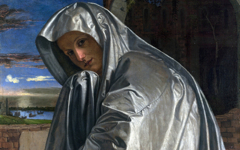
Titian’s Mary Magdalene(s) (c.1530-60)
Even in the remaining fragment of a much larger canvas there is still much to see
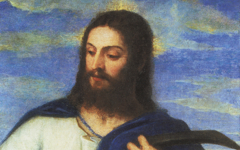
Titian’s Noli Me Tangere fragment (1553-4)
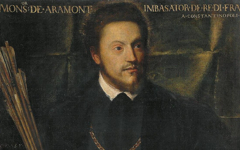
Look for the artist's initials where you might expect them
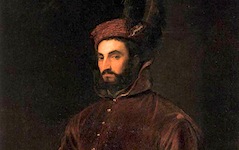
Titian’s Portrait of Ippolito de’ Medici (1533)
Get to know what painters and sculptors look like at work - and their various processes - and your brain will penetrate the surface of a painting in no time. A painting like this one...
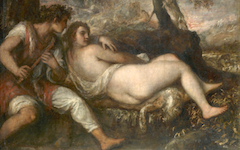
Titian’s Shepherd and Nymph (c.1575-6)
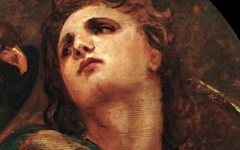
Find out what touching, hands and pointing fingers mean for Titian
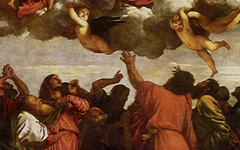
Titian’s Touch: Noli Me Tangere (1511-12), Assunta (1520) and Self-portrait (c1560-62)
See how Titian tricks us into thinking there is one reality in art when there are, at least, two
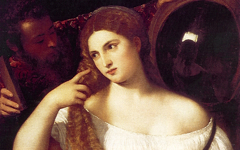
Titian’s Woman with a Mirror (1512-15)
If a poet uses a storm as a metaphor, who mistakes it for a real storm? Why do so in art?
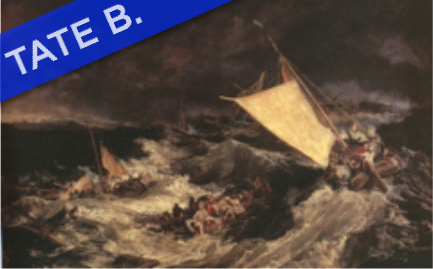
Turner’s The Shipwreck (1805)
Van Gogh is one of the few artists whose hidden elements revealed on EPPH confirm the conventional view of his art.
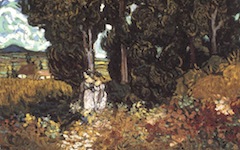
Van Gogh’s Cypresses with Two Female Figures (1889)
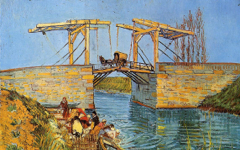
A spiritual journey is one of the basic plots of literature and a common metaphor in both philosophy and religion. Why not art?
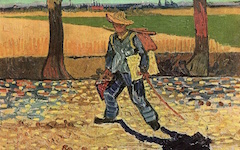
Van Gogh’s On the Road to Tarascon (1888)
Landscapes, if art, are never just landscapes. Are they even landscapes? The Chinese call them "Mindscapes"
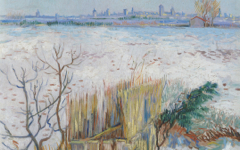
Van Gogh’s Snowy Landscape with Arles in the Background (1888)
See why knowledge of a painter's practice can lead to a different, and more accurate, interpretation of a scene.
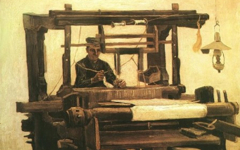
Van Gogh’s Weavers (1884)
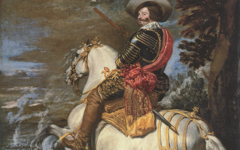
The Velazquez that the Louvre doesn't show anymore is not what curators think. Ask Millet, Manet, Degas, Matisse or Picasso....
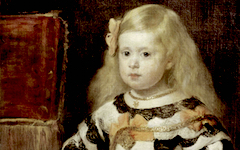
Velazquez’s Infanta Margarita (1653)
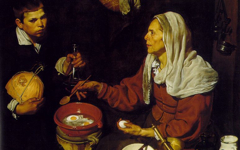
Discover how the figure of an actor by Velazquez contains far more than just the figure of an actor
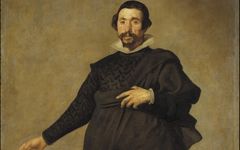
Velazquez’s Pablo de Vallodolid (1636-7)
See how Velazquez portrays the artist and his art and then apply the lesson learned elsewhere
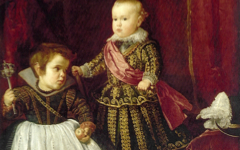
Velazquez’s Prince Baltasar Carlos with a Dwarf (1632)
There is more to Vermeer than a pretty scene and dull symbolism
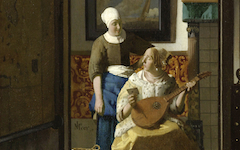
Vermeer’s The Love Letter (c.1669-70)
This picture uses so many of the themes and methods explained on EPPH that I can note only a few. Try exercising your own perception on the rest.
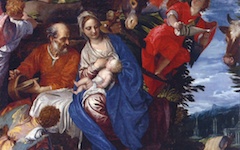
Veronese’s Rest on the Flight into Egypt (c.1572)
Sometimes one of the secrets of art is so obvious, no-one sees it
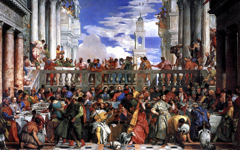
Veronese’s The Marriage at Cana (1563)
Page 4 of 4 pages ‹ First < 2 3 4
© Simon Abrahams. Articles on this site are the copyright of Simon Abrahams. To use copyrighted material in print or other media for purposes beyond 'fair use', you must obtain permission from the copyright owner. Websites may link to this page without permission (please do) but may not reproduce the material on their own site without crediting Simon Abrahams and EPPH.