20 Mar 2013 | 2 Comments
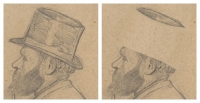
How Degas drew a top hat…
Art is so pregnant that even in a "simple" sketch like Degas' Edouard Manet at the Races (c. 1865) there is always something more. I thought I had drained the drawing when I finished writing about it yesterday (see entry). And, then, this m
16 Jan 2013 | 2 Comments
Sotheby’s Head Turner
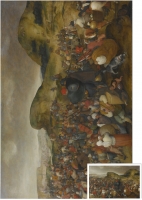
Two years ago, shortly after I began this website, Christie's sold one of the most important Old Master paintings to come on the market for years: Poussin's Ordination from the collection of the Duke of Rutland. The auction house helped by Pouss
04 Nov 2012
Art and the Human Mind
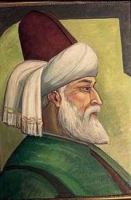
Rumi was a mystical poet born in what is now Afghanistan in 1207 and died in 1273. The world has learnt little since about being human that Rumi did not already know and his ancestors long before him. Technology and science may be new and

29 Oct 2012 | 1 Comments
Andy Warhol: The Only Way Out is In!
Here for those familiar with the site is a late print by Andy Warhol. It provides the quotation of the week: "The only way out is in!"

10 Oct 2012 | 1 Comments
Art, Generalization and Sight
One of the keys to understanding art is generalization because many of the most creative artists donate their ideas not to contemporaries or to those in the generation afterwards, who might not even understand, but to other great artists centuri
20 Sep 2012
Mondrian’s Esoteric Interests
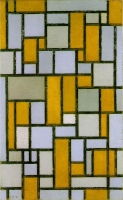
The spiritual and esoteric knowledge passed down in Western art from one generation to the next seems to remain constant regardless of which spiritual path the artist is interested in. There are dozens of possibilities, some more likely in one a
28 Aug 2012
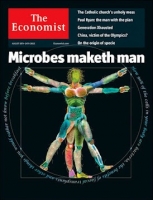
Microbes & Man: The Essence of Art
Who we are, or rather who each artist was, is crucial to our understanding of art in ways that the literature on art rarely, if ever, addresses. Yet once the concept every painter paints himself is seen as central to understanding the artist&rsq
05 Jul 2012
Higgs boson and the Arts
The Higgs boson may have been found. The news today is circling the globe faster than the speed of light, attracting elementary fascination. Everyone has their own twist on its significance to them even those, like me, whose knowledge of science
31 May 2012
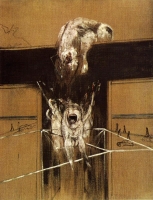
Francis Bacon on Portraits and Crosses
I’ve just been reading a series of essays on Francis Bacon and have come across two quotes that I must pass on. A young doctoral student had some long conversations with Bacon in 1975 in which Bacon was saying that when he looks at a great pai
03 May 2012
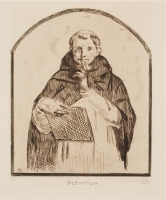
Art’s Tradition of Secrecy
Great poets are great poets because they have reached heights of spiritual understanding inaccessible to the crowd. The starting-point depends on the individual; some are born prophetic, others somewhere along the way. Those who begin at the bot
21 Apr 2012 | 2 Comments
Rembrandt and His Crucifixion (1631)
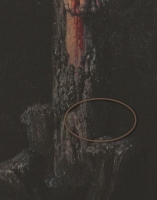
I can be very blind. Some time ago I added an analysis of Rembrandt’s Crucifixion in which I showed that Rembrandt had portrayed himself as Christ not out of delusions of grandeur but based on Christianity’s most fundamental principles

06 Mar 2012
Quotation of the Week 6
Plotinus' advice on how to see God is equally, or you might think even more, true about art:
‘For one must come to the sight with a seeing power made akin and like to what is seen. No eye
09 Feb 2012
The Artist as Creative God
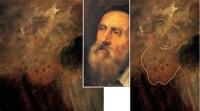
The idea within esoteric Christianity that God is our innermost self, the universal self that we all share, has inspired many Western artists over the centuries to depict themselves as God in the process of creation. The ceiling of the Sistine C
30 Dec 2011
Carpaccio’s Dragon’s Blood
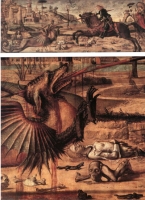
Carpaccio’s remarkable series of wall decorations on the saga of St. George in a small Venetian scuola captured my attention twelve years ago, at the start of my own quixotic quest to convince the art world that the subject of true art is
16 Dec 2011
Importance of Interpretation
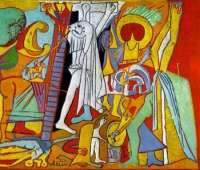
People use this site to help develop their ability to interpret works of art and thereby increase their aesthetic satisfaction. To look at art without trying to interpret it leaves you looking at a pretty picture, little more. Certainly the brus
05 Dec 2011
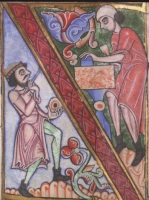
Urinary Colors
Perhaps Andres Serrano’s Piss Christ, a photo of a crucifix in a bottle of his own urine, is not so unusual after all. I’ve just learnt that the red dyes used for high-status textiles in the Middle Ages (ecclesiastical, regal etc.)&n
04 Dec 2011
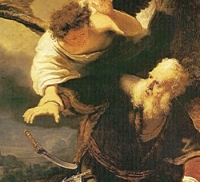
Interpretation and Art
Gnosticism was a word coined in the seventeenth century to encompass those early Christian traditions that did not take Jesus’ words at face value and were often deemed heretical by the establishment Church. Many early Christians searched
21 Nov 2011
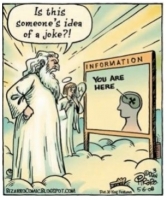
Is this someone’s idea of a joke?
Today I’m posting a cartoon from 2008 which I find quite surprising. The artist clearly felt that an esoteric idea we talk a lot about here - that God is not in heaven but in our minds - is widely enough known that he could make a joke abo
03 Oct 2011
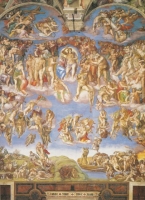
Being in the Image and Text
In many religious images on this site I have shown how the artist both illustrates their effort to unite with God and their own difficulties in creating the image itself. Paul Jay, a literary critic, found something similar in St. Augustine Conf
22 Sep 2011
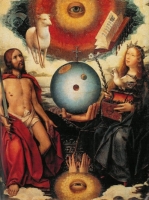
Quotation of the Week #2
"If thou wishest to search out the deep things of God, search out the depths of thine own spirit."1
Richard of St. Victor (died 1173), Mystical Theologian, Prior of the Abbey of St. Victor, Paris
18 Sep 2011
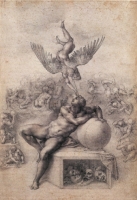
Christ’s Private Chamber
The Inner Tradition on which our theory of art depends is widespread, constant and ever-changing. All major artists are in one way or another influenced by some version of it. Aldous Huxley called it the “Perennial Philosophy”, ident
11 Sep 2011
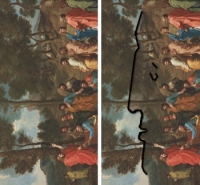
The Kimbell Gets a Surprise
Nicolas Poussin’s Sacrament of the Ordination (1640's) is one of the masterpieces of Western art. I wrote about it last year when it failed to sell at auction. Now the Kimbell Art Museum in Fort Worth, Texas has acquired it for $24 m
19 Aug 2011
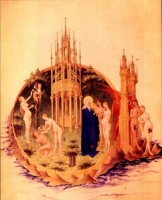
Two Medieval Churches
Ever since I became aware that masterpieces of Western art tend to make more sense viewed through the ideas of esoteric Christianity than through the Secular Church’s religious dogma, I have been curious why art historians write as though ther
30 Jul 2011 | 1 Comments
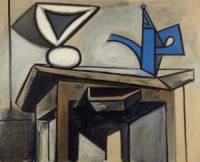
Titian is a dog
Some viewers remain convinced that artists subconsciously fused their features into their portraits of other people - as Leonardo misleadingly suggested - even though the evidence is now strong that face fusion was practiced consciously and with
28 Jun 2011
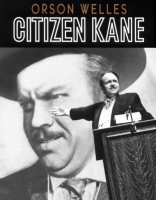
God is Welles
The theme on the site named 'Divine Artist' has recently revealed how frequently great masters depict themselves as God, Christ or the Holy Spirit. A paper on the Sistine Chapel explains how Michelangelo depicted himself as God and shorter entri
13 Jun 2011 | 1 Comments
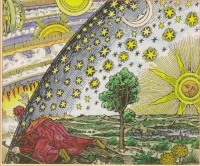
Breaking out of the World
For aeons men and women have thought that the stars in the night sky were pin-prick size holes in the fabric of the cosmos and that the bright light pouring in through these holes was visual evidence of a truer reality beyond. Above, in what is
27 Apr 2011
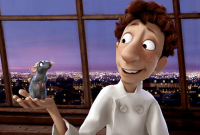
Ratatouille and the Great Masters (of all genders)
What do Raphael’s La Fornarina and Ratatouille have in common? Much more than you might think, their superficial differences disguising their fundamental similarity. The idea that significant art depicts a moment of its own making within t
22 Apr 2011
Titian as God
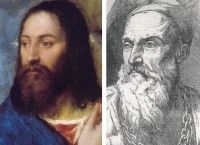
There's a whole new theme at Every Painter Paints Himself and one I've been looking forward to because more than any other theme on the site it demonstrates how artists followed the various traditions of mystical Christianity and not the
20 Apr 2011
Celebrating Good Friday
Isn’t it rather morbid and paradoxical for Christians to celebrate the death of Christ on Good Friday? What’s so good about killing your God? Ah, you’ll be told, that was the day He died for our sins for all humanity? But doesn
15 Mar 2011 | 2 Comments
Leo Steinberg and Christ’s Organ
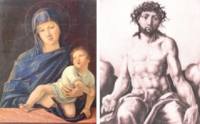
Leo Steinberg died two days ago in New York City at the age of 90. He was an art historian who wrote English clearly and had an unusual eye. His most important contribution was not, as is generally believed, his book Other Criteria in which he c
The EPPH Blog features issues and commentary.