23 Feb 2012
Faces in Our Minds
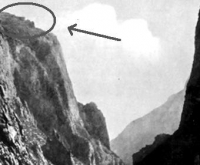
Humanity’s existence is so dependent on recognizing faces that our visual system specializes in it, reserving a large proportion of the brain’s neurons solely for that purpose. Amazingly we can even recognize a person in profile when we have
10 Feb 2012
Titian’s Danae..a “new” self-portrait
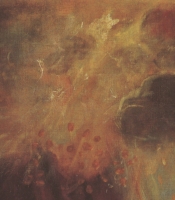
I've found a clearer image of Titian's own face, a previously unseen self-portrait, made from the clouds in his Prado Danae. You can see the tip of his nose in the center of this image, his far eye quite clearly indicated above it and sl
09 Feb 2012
The Artist as Creative God
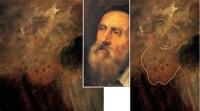
The idea within esoteric Christianity that God is our innermost self, the universal self that we all share, has inspired many Western artists over the centuries to depict themselves as God in the process of creation. The ceiling of the Sistine C
05 Feb 2012
What is Art?
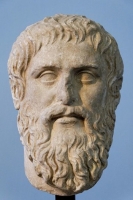
Edward de Bono, the polymath and creative thinker, has argued that argument as a way of thinking began with the Gang of Three: Socrates, Plato and Aristotle. Argument then became the default mode for human thought and while the method has served
04 Feb 2012
Physiognomy and Every Painter….
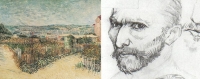
In the previous entry we saw how Degas’ beloved Little Dancer Aged Fourteen is partly modelled on the physiognomic ideas of Johann Caspar Lavater (1741-1801) and others. I mentioned this because Lavater also wrote: “Every painter paints
01 Feb 2012
Degas’ Disgusting Ballerina
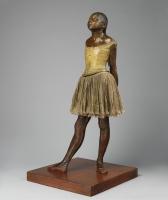
When Degas’ much beloved Little Dancer Aged Fourteen was first exhibited in 1881, it was greeted with fear and disgust. One art critic wrote that Degas had selected a model “among the most odiously ugly; he makes it the standard of horror an
31 Jan 2012
Hollywood and the Man Within My Head
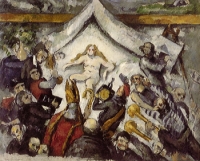
I’m always intrigued on perusing The Times Book Review by how many articles explain the object of their study in terms similar to those used here. It is no coincidence, of course. Every painter paints himself and all it entails is probably
29 Jan 2012
Leonardo on Creating Art as the Subject of Art
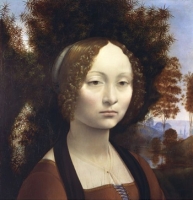
I often argue that the subject of a painting is its own making and have already demonstrated this online in several hundred entries, including examples by Leonardo.1 Evidence in written commentary by artists, though, is much rarer. Nevertheless
30 Dec 2011
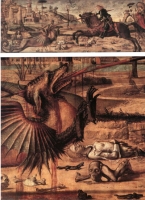
Carpaccio’s Dragon’s Blood
Carpaccio’s remarkable series of wall decorations on the saga of St. George in a small Venetian scuola captured my attention twelve years ago, at the start of my own quixotic quest to convince the art world that the subject of true art is
22 Dec 2011
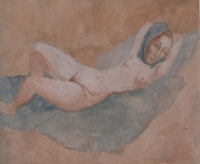
Quiz: Can you see what Picasso’s up to?
OK, here's your chance to figure out a drawing before I give you my opinion. It's by the young Picasso of his girlfriend when they were on a summer vacation in the Spanish Pyrenees. It seems simple enough but nothing by Picasso is really
21 Dec 2011
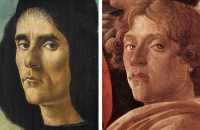
The Renaissance Portrait from Donatello to Bellini #5
Continuing our series in honor of the Metropolitan Museum's current exhibition of Renaissance portraits we have Botticelli's portrait of Michele Marullo Tarcaniota on the left compared to Botticelli's earlier self-portrait on the rig
16 Dec 2011
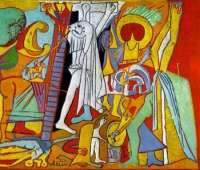
Importance of Interpretation
People use this site to help develop their ability to interpret works of art and thereby increase their aesthetic satisfaction. To look at art without trying to interpret it leaves you looking at a pretty picture, little more. Certainly the brus
10 Dec 2011
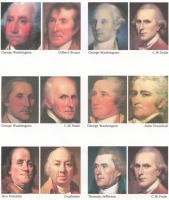
Portraits: Icons of America
Portraits make popular art exhibitions because we all think we can “read” a face. It’s part of being human. Everyone is his or her own expert on other people’s faces. Besides, portraits help satisfy our natural inquisitiv
05 Dec 2011
Urinary Colors
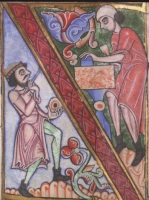
Perhaps Andres Serrano’s Piss Christ, a photo of a crucifix in a bottle of his own urine, is not so unusual after all. I’ve just learnt that the red dyes used for high-status textiles in the Middle Ages (ecclesiastical, regal etc.)&n
04 Dec 2011
Interpretation and Art
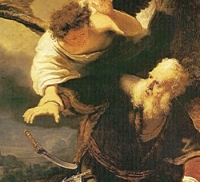
Gnosticism was a word coined in the seventeenth century to encompass those early Christian traditions that did not take Jesus’ words at face value and were often deemed heretical by the establishment Church. Many early Christians searched

03 Dec 2011
The Renaissance Portrait from Donatello to Bellini #4
This one is a complete head-scratcher. It's a little after the Renaissance, obviously, but not long after. Why no specialist has ever noticed that Rubens' portrayal of the Duke of Buckingham in this oil sketch (left) is identical to his
02 Dec 2011
The Renaissance Portrait from Donatello to Bellini #3
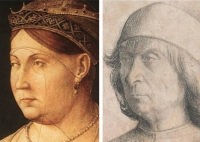
Both portraits above will be in the exhibition at the Metropolitan Museum (Cat. #163 and #159) and may even be hung near to each other where the similarity will surely be noticed. The portrait of Caterina Cornaro, Queen of Cyprus (left), i

01 Dec 2011
The Renaissance Portrait from Donatello to Bellini #2
For a late portrait Raphael was asked to paint a Neapolitan princess he had never seen, a problem he solved by sending Giulio Romano to Naples do a drawing from life. The painted portrait (left) was mostly done by studio assistants after a desig
30 Nov 2011
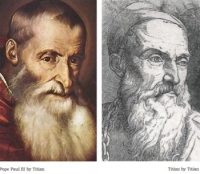
The Renaissance Portrait from Donatello to Bellini
On December 21st the Metropolitan Museum, New York, will be opening an exhibition titled The Renaissance Portrait from Donatello to Bellini. As long-time users know, the whole idea behind this site and its blog is that art, especially Renaissanc
29 Nov 2011
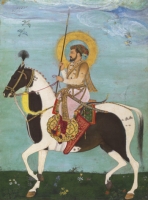
Wonder of the Age: Master Painters of India
What a difference! The Metropolitan Museum’s new exhibition of Indian art, Wonder of the Age, Master Painters of India 1100-1900, is a joy to visit. Instead of a confusing mass of breath-taking illuminations by anonymous craftsmen, as exhi
23 Nov 2011
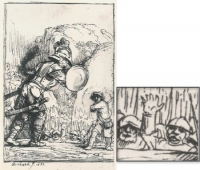
Rembrandt’s Hand
We have already seen (in Donatello’s Davids and Goliaths) that Donatello identified with both David and Goliath. Both his giants (in the marble and bronze versions) have double vision, out-sight and insight, the two forms conveyed by one eye o
21 Nov 2011
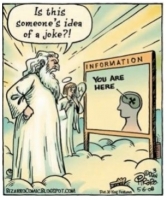
Is this someone’s idea of a joke?
Today I’m posting a cartoon from 2008 which I find quite surprising. The artist clearly felt that an esoteric idea we talk a lot about here - that God is not in heaven but in our minds - is widely enough known that he could make a joke abo
16 Nov 2011
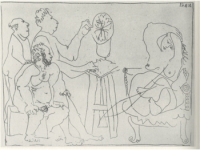
Picasso’s Visual Illusions In the Sculptor’s Studio
Some of Picasso's late etchings look as though they may have been tossed off without much thought. It's only when you can begin to study them closely that you realize how brilliant he was. In this print called In the Sculptor's Studi
16 Nov 2011
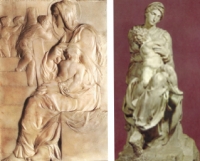
Michelangelo’s Madonna of the Stairs (c.1491) and the Medici Madonna (1521-34)
Sometimes the explanation of an artwork does not fit well into the site's template. Michelangelo's Madonna of the Stairs and the Medici Madonna are two that work better in the form of a short essay. I've just added one on the two of them an

10 Nov 2011
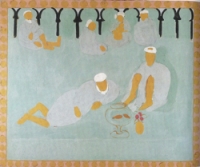
The Importance of an Artist’s Turban
I've been looking forward to discussing turbans for some time because, for an art lover, a little knowledge can go a long way. Almost everyone thinks of them as oriental in some manner but, up until the end of the eighteenth century, you could f
04 Nov 2011
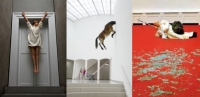
Maurizio Cattelan at the Guggenheim
The Maurizio Cattelan exhibition opening today at the Guggenheim New York (on till Jan 22nd, 2012) is entitled All because it is meant to be a complete retrospective of the Italian artist’s career. In fact, aged 51, he has formally announc
04 Nov 2011
Quotation of the Week #5
‘…the symbolical creations of geniuses are unfortunately harder to nail down to a definite subject than the allegorical inventions of minor artists.’
Erwin Panofsky, art historian (1892-1968)1
30 Oct 2011 | 2 Comments
Cubism Explained
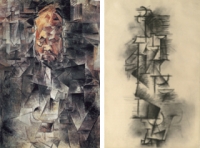
No-one, to my mind, has ever satisfactorily explained Cubism. Indeed I have found the explanations and their complexity totally confusing. Roland Penrose, a close friend of Picasso, claimed that Cubist images try:
‘to state t
28 Oct 2011 | 3 Comments
Why so few female artists?
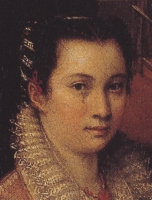
I sometimes get emails from female art historians upset with the male-centric focus of this site. They usually end with "Every painter paints herself too, you know”, with one memorably complaining that our work here is "testosterone-fuelled."
21 Oct 2011
The World’s Oldest Studio and the Birth of Venus
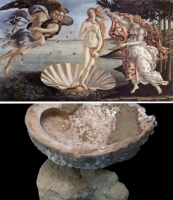
Just three weeks ago I argued that the shell in Botticelli's Birth of Venus referred to the shells artists used in their studios to store paint and that Venus was, so to speak, being born from an artist's palette. Now comes word that arc
The EPPH Blog features issues and commentary.