20 Oct 2011
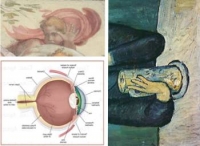
Picasso’s Eyeball
Yesterday I asked if anyone knew of a link between Manet’s Absinthe Drinker and Picasso’s Blue Period paintings. There are several. They both use Marcantonio Raimondi’s Portrait of Raphael, a small engraving, as their source; both were pai
19 Oct 2011
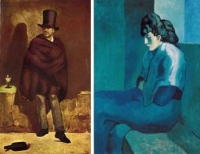
Find the link
What do you think links Manet's Absinthe Drinker to Picasso's Blue Period paintings?
Answer here.
17 Oct 2011
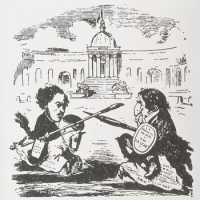
Delacroix on Color and Line
Writers on art once believed that Raphael and the School of Rome privileged line and contour whereas Titian and the Venetian School worshipped color, thereby making the overall palette and tonality of Venetian pictures in the Renaissance more si
13 Oct 2011
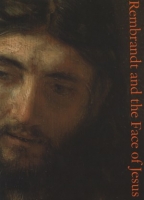
Rembrandt and the Face of Jesus
America’s a religious and largely Christian country so an exhibition titled Rembrandt and the Face of Jesus, currently in Philadelphia and soon to travel to Detroit, ought to be a popular hit. It caught my interest because – face it
10 Oct 2011
Quotation of the Week #4
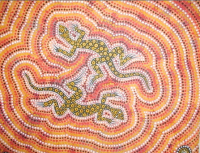
"Meaning is for those who are ready for it, for those who are trained for it. The rest get pretty pictures."
Les Bursill, an aborigine on aboriginal art
04 Oct 2011
John Sloan and his Ashcan Paintings
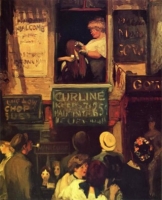
I mentioned a month ago that I would be reviewing Michael Lobel’s article in the Art Bulletin on John Sloan, the Ashcan artist of early twentieth-century New York.1 In it he looks at half a dozen works by Sloan between 1907 and 1910 to dem
03 Oct 2011
Being in the Image and Text
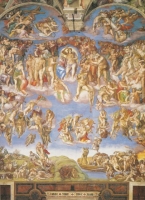
In many religious images on this site I have shown how the artist both illustrates their effort to unite with God and their own difficulties in creating the image itself. Paul Jay, a literary critic, found something similar in St. Augustine Conf
01 Oct 2011
Quotation of the Week #3
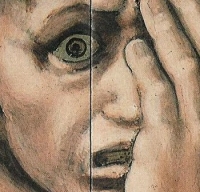
“In painting, the idea is an image that the intellect of the painter has to see with interior eyes in the greatest silence and secrecy.”1
Michelangelo Buonarotti (1475-1564)
30 Sep 2011
Dylan’s Sources
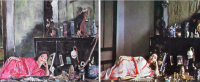
Now comes the story of Bob Dylan’s paintings, currently on view at Gagosian New York. I have only seen photos but, given the buzz, I’ll be there next week. I didn’t know but Dylan, like many artists, has long been known for usi
27 Sep 2011
Matisse on Making a Portrait
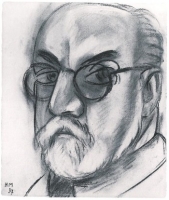
In 1937 Henri Matisse made some charcoal portraits of Henry de Montherlant, a French playwright whom Matisse had met the year before. The artist’s account of the process is quite revealing. The issues which art historians traditionally assume
22 Sep 2011
Quotation of the Week #2
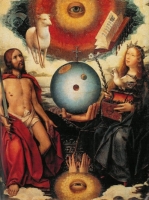
"If thou wishest to search out the deep things of God, search out the depths of thine own spirit."1
Richard of St. Victor (died 1173), Mystical Theologian, Prior of the Abbey of St. Victor, Paris

20 Sep 2011
Seinfeld falls in love
OK, if Seinfeld fell in love, who would he fall in love with? This short excerpt’s somewhat funny because the object of his love is actually a girl. Seinfeld understands the human mind like an artist – he’s the writer too, afte
18 Sep 2011
Christ’s Private Chamber
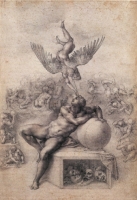
The Inner Tradition on which our theory of art depends is widespread, constant and ever-changing. All major artists are in one way or another influenced by some version of it. Aldous Huxley called it the “Perennial Philosophy”, ident
17 Sep 2011
Artists are Animals
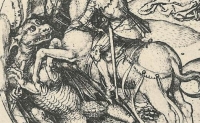
“Artists are animals” may seem like a derogatory statement but artists are animals and both art and intelligence are products of nature. We are not separate. We all play our part in the cosmos, all created by similar processes: rats,
11 Sep 2011
The Kimbell Gets a Surprise
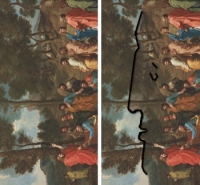
Nicolas Poussin’s Sacrament of the Ordination (1640's) is one of the masterpieces of Western art. I wrote about it last year when it failed to sell at auction. Now the Kimbell Art Museum in Fort Worth, Texas has acquired it for $24 m

09 Sep 2011
Murder and Butchery by Picasso and Chagall
A recent article on Chagal discusses his well-known identification with animals. It concludes with a drawing called The Butcher (top) which is so similar in meaning and method to Picasso’s The Murder (bottom), both drawn in the early 1930
02 Sep 2011
Art Bulletin’s Bumper Issue
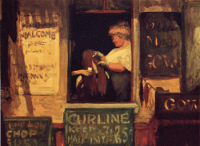
This month’s Art Bulletin, the magazine of the U.S. College Art Association, is a bumper issue as far as we are all concerned. One article by Michael Lobel reveals how John Sloan, a member of the Ashcan School in early twentieth-century Americ
31 Aug 2011
The Importance of Source-Hunting
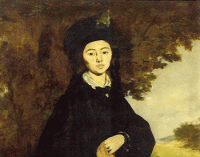
Source-hunting, searching for the origin of a form in an earlier artist’s work, is one of the most maligned activities in art scholarship. John Shearman, a professor of the history of art at Harvard, wrote:
‘The study of sou
30 Aug 2011
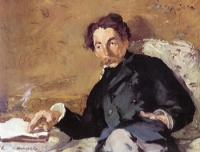
Do Poets understand Painting?
A couple of days ago I questioned whether the poets in an artist’s social circle have any greater understanding of their friend’s art than we do. I am always surprised by how art historians give so much credit to the opinions of poet
29 Aug 2011
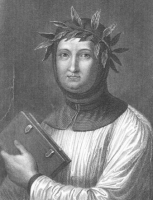
Petrarch on Imitation
I have always doubted whether the poets and writers in an artist's social circle have any greater understanding of visual art than we have. They are, of course, deeply familiar with poetic techniques in writing but seem blind to them in art.
26 Aug 2011 | 2 Comments
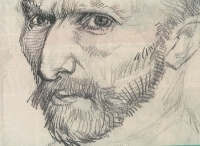
Quotation of the Week #1
"For a painter, it is probably twice as interesting if, while painting a nest, he dreams of a cottage and, while painting a cottage, he dreams of a nest. It is as though one dreamed twice, in two registers, when one dreams of an image cluster su
25 Aug 2011
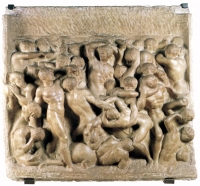
Michelangelo’s Battle with Stone
One of Michelangelo’s earliest sculptures, Battle of the Lapiths and Centaurs, depicts a battle scene in which stones are hurled between the combatants. Barolsky noted that the choice of stones as a weapon was not specified by the classical po
23 Aug 2011
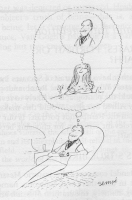
Dreaming in Art vs. Illustration
“How do you know that this is a picture of him dreaming of her dreaming of him?” That is the question four art historians ask in a 1989 book titled Puzzles about Art. They don’t try to resolve their question about The New Yorke
19 Aug 2011
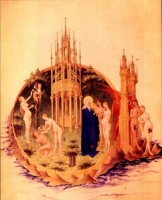
Two Medieval Churches
Ever since I became aware that masterpieces of Western art tend to make more sense viewed through the ideas of esoteric Christianity than through the Secular Church’s religious dogma, I have been curious why art historians write as though ther
02 Aug 2011
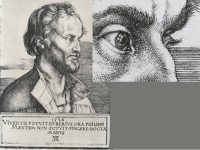
Dürer’s Portrait of Philip Melanchthon (1526)
Durer’s 1526 Portrait of Philip Melanchthon is notable for the manner in which the artist treats the eyes. One eye is large, bright and clear; the other mostly unseen, the tip of its eyelash just visible above the clouds. This contras
30 Jul 2011 | 1 Comments
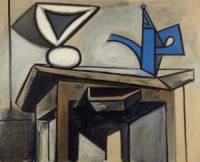
Titian is a dog
Some viewers remain convinced that artists subconsciously fused their features into their portraits of other people - as Leonardo misleadingly suggested - even though the evidence is now strong that face fusion was practiced consciously and with

25 Jul 2011
“.....And that impact is him.”
A user kindly sent me a link to William Feaver's appreciation of his long friendship with Lucian Freud which appeared in a UK newspaper yesterday. You can read the full article at The Guardian but here are a couple of excerpts:
"The
20 Jul 2011
A Musical Eco
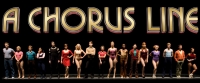
Umberto Eco once wrote that “Every Broadway musical is, as a rule, nothing other than the story of how it is put on.”1 His insight into what the various plots have in common is striking because it is equally true of great paintings. The
18 Jul 2011
Show me the Money!
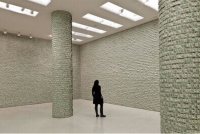
If you are in New York, do visit Hans-Peter Feldman’s winning installation for the annual Hugo Boss Guggenheim prize. The prize is $100,000 so Feldman took the exact amount in dollar bills and pinned all 100,000 of them to the walls and co
12 Jul 2011
Introducing Bellini’s “Eyes”
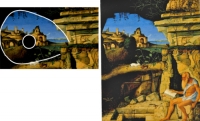
I have recently introduced the argument that a significant number of compositions by Giovanni Bellini are not just representations of the apparent scene but, on another level, are representations of giant “heads”, “faces” or parts of fac
The EPPH Blog features issues and commentary.